Finishing a PhD is a huge milestone, but for many graduates, it raises a new question: what comes next? One common answer is a postdoctoral position, often discussed alongside broader doctoral programs as the next logical step in an academic or research career. If you’ve ever wondered what these programs actually involve, how they differ from your PhD, and whether one makes sense for you, this guide walks through everything you need to know.
Whether you’re a recent graduate weighing your options or a mentor guiding a student, understanding how postdoctoral roles fit into the wider landscape of doctoral programs will help you make a more informed decision.
What Is a Postdoctoral Program?
A postdoctoral program, often shortened to “postdoc,” is a temporary research position taken after completing a PhD. It’s designed to give recent doctoral graduates the chance to deepen their research skills, publish work, and build a track record before moving into a permanent role, whether that’s in academia, industry, or a government institution.
Unlike doctoral programs, which are structured around coursework, exams, and a dissertation, postdoctoral positions are almost entirely research-focused. There’s no formal degree awarded at the end. Instead, the value comes from the experience, publications, and professional network you build.

How Postdoctoral Programs Differ From Doctoral Programs
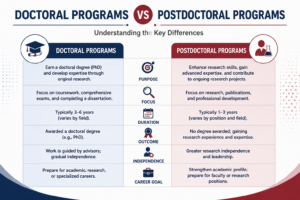
It’s easy to confuse postdoctoral programs with doctoral programs since both happen in academic or research settings. Here’s a simple breakdown of the differences.
| Feature | Doctoral Programs | Postdoctoral Programs |
| Degree awarded | PhD or equivalent | No degree awarded |
| Duration | 3–7 years | 1–5 years |
| Structure | Coursework + dissertation | Independent research |
| Supervision | Close faculty advising | More autonomy |
| Goal | Earn a doctorate | Build research experience and publications |
| Funding | Tuition waivers, stipends, assistantships | Salaried research position or fellowship |
In short, doctoral programs train you to become an independent researcher. Postdoctoral programs let you practice being one.
Why Do PhD Graduates Pursue a Postdoc?
Not every PhD graduate needs a postdoc, but many choose this path for specific reasons.
- Building a stronger publication record for competitive academic job markets
- Gaining specialized skills not covered during doctoral programs
- Transitioning fields, such as moving from one research area to an adjacent one
- Meeting eligibility requirements for certain faculty or research positions
- Expanding professional networks through collaboration with new labs or institutions
For fields like the life sciences, physics, and chemistry, a postdoc is often close to a requirement for landing a tenure-track position. In other fields, like some social sciences or professional disciplines, it’s less common and more optional.
Types of Postdoctoral Programs
Postdoctoral opportunities come in several forms, and the right one depends on your field and career goals.
1. Academic Postdocs
Based at universities, these focus on research output, teaching opportunities, and preparing for a faculty role.
2. Industry Postdocs
Offered by private companies, particularly in pharmaceuticals, tech, and engineering, these blend research with applied, commercial goals.
3. Government or National Lab Postdocs
Positions at government-funded research institutions, often with access to specialized equipment and large-scale projects.
4. Fellowship-Funded Postdocs
Independently funded through grants or fellowships, giving researchers more freedom to choose their own project and institution.

What Does a Typical Postdoc Involve?
While every position looks different, most postdoctoral programs share a few common elements:
- Conducting independent or supervised research
- Publishing in academic journals
- Applying for grants or fellowships
- Presenting at conferences
- Mentoring graduate or undergraduate students
- Collaborating with faculty and other researchers
The daily work can look a lot like doctoral programs in terms of lab or research routines, but with far more independence and less formal instruction.
How Long Do Postdoctoral Programs Last?
Most postdoc positions run between one and three years, though some extend to five years, especially if a researcher completes multiple postdoc stints before securing a permanent role. Contracts are usually renewed annually based on funding availability and performance.
How to Find and Apply for Postdoctoral Programs
If you’re finishing your PhD and considering this route, here’s a general approach:
- Identify your target field or lab. Look for researchers doing work aligned with your interests.
- Check funding sources. Some postdocs come with guaranteed funding; others require you to apply for grants yourself.
- Prepare a strong research statement. This should outline your past work and proposed research direction.
- Request letters of recommendation from your doctoral advisors early.
- Apply broadly. Many candidates apply to multiple labs, institutions, or fellowship programs at once.
Platforms and academic networks focused on global education and research opportunities can also help graduates compare postdoctoral openings across countries and institutions, making the search less limited to your home country’s academic circle.
Is a Postdoc Right for You?
A postdoc isn’t the only path after doctoral programs. Consider a postdoc if:
- You want a career in academic research or a tenure-track faculty position
- Your field expects postdoctoral experience before hiring for permanent research roles
- You need more time to build publications or specialize further
Consider skipping a postdoc if:
- You’re aiming for industry roles that value the PhD itself over additional research experience
- You have a clear job offer that doesn’t require it
- You’re ready to move into teaching, consulting, or applied work immediately
There’s no universally “correct” choice. It depends on your field, goals, and the opportunities available to you.
Conclusion
Postdoctoral programs serve as a bridge between the structured world of doctoral programs and full independence as a researcher or academic. They offer valuable time to build expertise, publish research, and figure out your next career step, without the pressure of a permanent position just yet.
For graduates exploring international research and academic opportunities, resources like ED Global Academy can help connect PhD holders with global education platforms, funding insights, and research communities beyond their local network.
If you’re currently finishing your PhD, start researching postdoctoral opportunities early, talk to your advisors, and think honestly about whether this step aligns with where you want your career to go.
Frequently Asked Questions
What is the difference between a PhD and a postdoc?
A PhD is a formal degree earned through doctoral programs involving coursework and a dissertation. A postdoc is a temporary research position taken after earning that degree, with no additional degree awarded.
Do you need a postdoc to become a professor?
In many science and research-heavy fields, yes, a postdoc is often expected or required. In other fields, it’s less common and depends on the institution and discipline.
How long does a postdoctoral position typically last?
Most positions last one to three years, though researchers sometimes complete more than one postdoc before securing a permanent role.
Are postdoctoral positions paid?
Yes, postdocs are typically salaried positions or funded through fellowships and grants, unlike doctoral programs, which often rely on stipends or tuition waivers.
Can you do a postdoc in a different field than your PhD?
Yes, many researchers use a postdoc to pivot into an adjacent field or gain new technical skills outside their original doctoral specialization.

Online PhD with Dissertation: How Long Does It Take?
October 9, 2026[…] Read also: What Are Postdoctoral Programs? A Complete Guide for PhD Graduates […]