
Earning a doctorate takes years of research, writing, and specialized training, so it’s natural to wonder what kind of return that investment brings. A PhD program doesn’t just open doors to academia anymore; it also leads to some of the highest-paying careers across industries like technology, healthcare, finance, and consulting.
In this guide, we’ll walk through the top-paying career paths available to PhD graduates, what makes these roles so lucrative, and how to position yourself for success after you finish your degree. Whether you’re currently enrolled in a PhD program or just starting to research your options, this article will help you understand where your doctorate can take you.
Why PhD Graduates Command High Salaries
In this guide, we’ll walk through the top-paying career paths available to PhD graduates, what makes these roles so lucrative, and how to position yourself for success after you finish your degree. Whether you’re currently enrolled in a PhD program or just starting to research your options, this article will help you understand where your doctorate can take you.
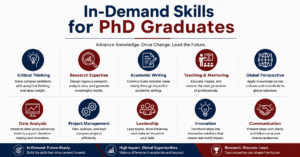
Employers value PhD holders because they bring a rare combination of skills to the table:
- Deep subject-matter expertise built through years of specialized study
- Advanced research and analytical skills that translate directly into solving complex business problems
- Independent thinking and problem-solving developed through original dissertation work
- Strong writing and communication skills, refined through publishing and presenting research
- Persistence and project management, since completing a doctorate requires managing long-term, self-directed work
These qualities are in high demand outside of academia, which is one reason non-academic careers now offer some of the best-paying opportunities for PhD graduates.

Highest-Paying Careers After a PhD Program
1. Data Scientist / Machine Learning Engineer
PhD graduates in fields like computer science, statistics, mathematics, and physics are highly sought after in data science and artificial intelligence. Companies value the ability to design experiments, build models, and interpret complex data sets.
- Typical fields: Computer Science, Statistics, Mathematics, Physics, Engineering
- Why it pays well: High demand for advanced modeling and AI expertise across every industry
- Career growth: Strong path toward roles like Lead Data Scientist, AI Research Scientist, or Director of Data Science
2. Pharmaceutical and Biotech Research Scientist
A PhD program in chemistry, biology, or pharmacology can lead directly into drug development and biotech research roles, where salaries are among the highest in the private sector.
- Typical fields: Biology, Chemistry, Pharmacology, Biomedical Engineering
- Why it pays well: High-stakes research with significant commercial value
- Career growth: Senior Scientist, Principal Investigator, or R&D Director
3. Management or Strategy Consultant
Top consulting firms actively recruit PhD graduates for their analytical rigor and ability to break down complex problems, especially in fields like economics, engineering, and physical sciences.
- Typical fields: Economics, Engineering, Physics, Social Sciences
- Why it pays well: Consulting firms pay a premium for structured problem-solving and client-facing expertise
- Career growth: Partner or Principal roles with significant compensation upside
4. Quantitative Analyst (“Quant”) in Finance
PhD holders in mathematics, physics, statistics, and computer science are heavily recruited by investment banks and hedge funds to build trading models and manage risk.
- Typical fields: Mathematics, Physics, Statistics, Computer Science
- Why it pays well: Financial firms pay top compensation for advanced quantitative modeling skills
- Career growth: Senior Quant, Portfolio Manager, or Head of Quantitative Research
5. University Professor (Tenured, Research-Intensive Institutions)
While academic salaries vary widely, tenured professors at top-tier research universities, particularly in business, engineering, medicine, and law, can earn competitive salaries alongside research funding and consulting opportunities.
- Typical fields: All disciplines, with business, engineering, and medical fields paying the most
- Why it pays well: Combines base salary with grants, consulting, and intellectual property royalties
- Career growth: Endowed chair positions and administrative leadership roles
6. Patent Attorney or Patent Agent
A PhD in a technical field, combined with legal training, qualifies graduates for one of the most lucrative intersections of science and law.
- Typical fields: Engineering, Chemistry, Biology, Computer Science
- Why it pays well: Technical expertise plus legal credentials is a rare and valuable combination
- Career growth: Partner-track roles at intellectual property law firms
7. Corporate Research and Development (R&D) Director
Large corporations in tech, energy, and manufacturing hire PhD graduates to lead R&D teams, guiding product innovation from concept to market.
- Typical fields: Engineering, Chemistry, Materials Science, Computer Science
- Why it pays well: Leadership responsibility over high-value innovation pipelines
- Career growth: VP of R&D or Chief Technology Officer
8. Economist (Government, Central Banks, or Private Sector)
PhD economists work in policy-making institutions, central banks, and private firms, applying advanced modeling to real-world economic questions.
- Typical fields: Economics, Applied Mathematics
- Why it pays well: High demand for economic forecasting and policy expertise
- Career growth: Senior Economist or Chief Economist roles
Comparing Career Paths
| Career Path | Best-Fit PhD Fields | Salary Potential | Work Setting |
| Data Scientist / ML Engineer | CS, Statistics, Math | Very High | Tech, Corporate |
| Biotech Research Scientist | Biology, Chemistry | High | Pharma, Biotech |
| Management Consultant | Economics, Engineering | Very High | Consulting Firms |
| Quantitative Analyst | Math, Physics, CS | Very High | Finance |
| Tenured Professor | All fields | Moderate–High | Academia |
| Patent Attorney | STEM + Law | Very High | Law Firms |
| R&D Director | Engineering, Sciences | High | Corporate |
| Economist | Economics | High | Government, Private |
How to Position Yourself for a High-Paying Career After Your PhD
- Build transferable skills early. Take on projects involving data analysis, coding, or leadership, even during your dissertation years.
- Network outside academia. Attend industry conferences, join professional associations, and connect with alumni working in your target field.
- Tailor your resume for industry. Translate academic accomplishments into business-relevant language that highlights impact, not just publications.
- Consider internships or fellowships. Programs designed for PhD graduates transitioning into industry can provide valuable hands-on experience.
- Stay current with in-demand tools. Skills like programming languages, statistical software, and data visualization tools are often expected in industry roles.
For learners exploring which doctoral path aligns best with these high-paying career outcomes, platforms like Ed Global Academy, a global education platform connecting students with accredited programs, can help identify the right PhD program based on career goals and industry demand.
Conclusion
A PhD program is a significant investment of time and effort, but it can lead to some of the most rewarding and highest-paying careers available today. From data science and biotech research to consulting and finance, doctoral graduates are well-positioned to secure roles that reward their expertise, analytical skills, and independent thinking.
If you’re considering a doctorate or are already enrolled, start building industry connections and transferable skills now. The earlier you plan your path, the more career options you’ll have after graduation.
Frequently Asked Questions
What is the highest-paying career after a PhD?
Careers in quantitative finance, data science, and management consulting tend to offer the highest salaries for PhD graduates, particularly for those with backgrounds in mathematics, computer science, or engineering.
Do PhD graduates earn more than master’s degree holders?
On average, PhD holders earn more than master’s degree holders, especially in fields like data science, engineering, and specialized research roles, though the gap varies by industry.
Can I get a high-paying job outside academia with a PhD?
Yes. Many of the highest-paying roles for PhD graduates today are in industry, including tech, finance, consulting, and pharmaceuticals, not academia.
Which PhD fields lead to the best salaries?
Computer science, engineering, physics, mathematics, and economics tend to offer the strongest salary outcomes, particularly when paired with industry experience.
Is a PhD worth it financially?
For many high-demand fields, yes, especially when graduates move into industry roles like data science or consulting. However, the financial return varies significantly by field and career path.
What skills do employers value most from PhD graduates?
Employers value analytical thinking, research skills, technical expertise, and the ability to manage complex, long-term projects independently.
