
Many students ask whether they can earn a doctorate from home while working. The answer is “sometimes,” and it depends heavily on the country and the regulator. Maybe you are a teacher who wants a PhD for a better post. Or you are a working professional who cannot attend classes every day. Online study sounds like the perfect answer, and many advertisements promise exactly that.
But not every offer is genuine. Some degrees are accepted for jobs and further study, while others are not recognized at all. One wrong choice can cost you years of effort and a lot of money. This guide explains how online doctoral study works, what the rules say in India, and what to check before you pay a single rupee.
Read more: How Long Does an Online PhD with Dissertation Take to Complete?
What Is an Online PhD Program?
An online PhD program is a doctoral research degree where some or most learning, supervision, and communication happen over the internet. Students usually study from home, meet a guide through video calls, and submit a thesis. However, the rules differ by country, and recognition depends on the awarding university and its regulator. A PhD is not a normal course with fixed classes. It is a long research project where you find a gap in existing knowledge and try to fill it.Online study changes how you meet your supervisor and access journals. It does not make the research lighter.

How Does an Online Doctorate Work?
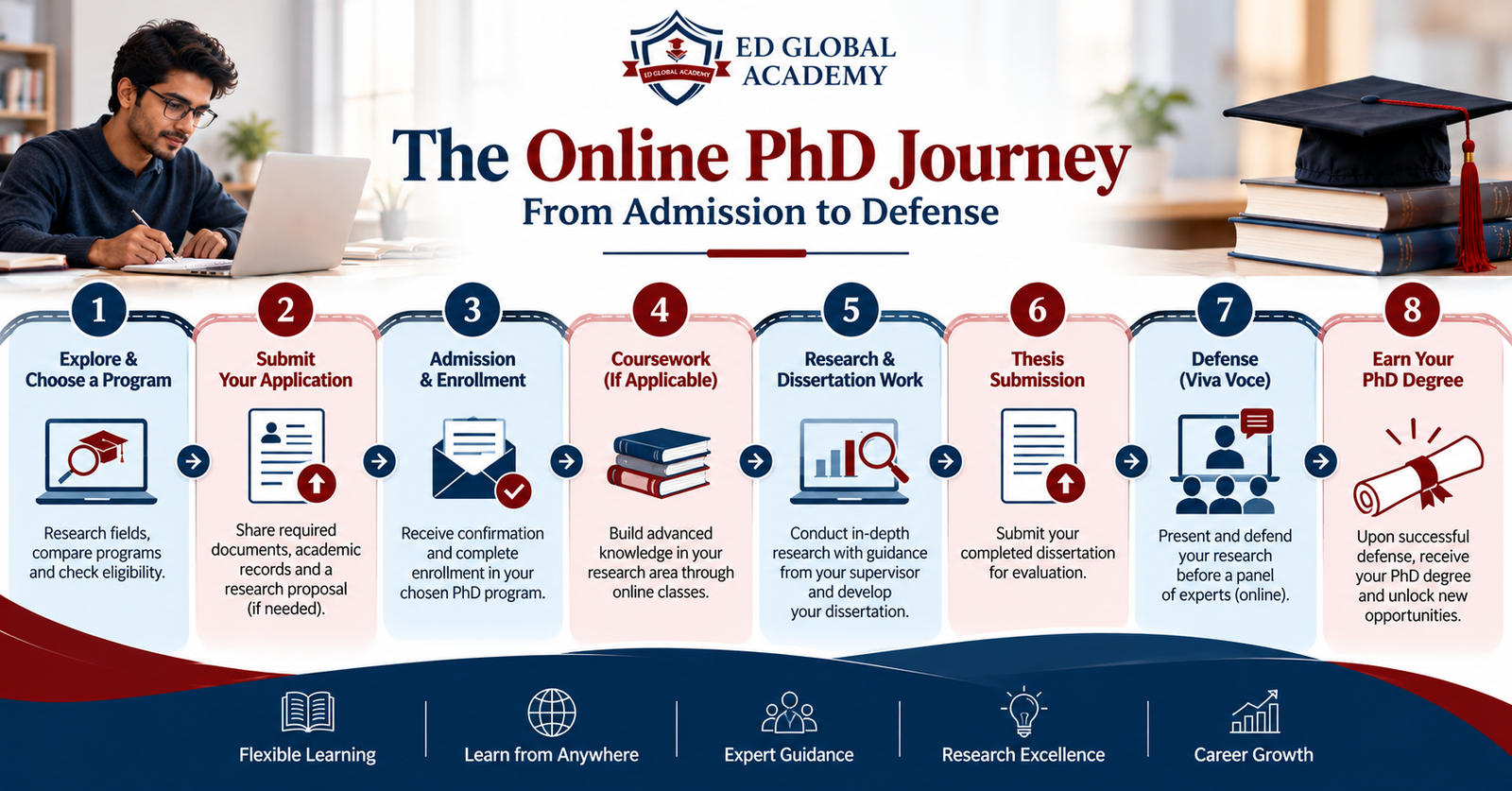
Most online doctorates run in three stages: coursework, a research proposal, and a thesis defense. You read papers, meet your supervisor on scheduled calls, and collect data for your study. Some universities still ask you to visit the campus for exams, workshops, or the final viva.
Here is a simple example of the journey:
- You join and complete research methods coursework.
- You pick a topic, for example, “How remote teaching affects rural student marks.”
- You write a proposal, and a committee approves it.
- You collect data, analyze it, and write chapter by chapter.
- You submit the thesis and defend it in a viva.
Your supervisor matters more than the platform. A good guide gives timely feedback and helps you publish. A weak one can slow you down for years.
Is an Online PhD Valid in India?
In India, a fully online PhD is not recognized. The UGC has warned students against online doctoral courses offered by EdTech companies with foreign institutions. Its 2022 regulations also define the PhD as a conventional face-to-face degree, excluding distance and online modes. Always check the regulator’s notices before paying any fee.
This is the most important point in this article, and many advertisements skip it.
What this means for you:
- Indian universities can offer regular PhDs, including part-time options, under UGC rules.
- Online courses can count as part of coursework credits in some cases, but the research degree itself follows UGC norms.
- A foreign online degree may not be accepted for teaching posts or government jobs in India.
- Degrees from abroad usually need an equivalence check from the Association of Indian Universities.
If someone promises “UGC-valid, 100% online PhD,” ask for the written notice. If they cannot show one, walk away.
How Long Does an Online PhD Take?
Timelines vary widely, but most students need several years. Factors include
- Study pace: Full-time students generally finish faster than part-time students.
- Program structure: Some programs follow a cohort model with set timelines; others are self-paced.
- Dissertation progress: This phase is the biggest variable and depends on your topic, data access, and advisor feedback.
- Prior credits: A relevant master’s degree may shorten the coursework portion.
Ask each program for its average time to completion and its completion rate, not just the advertised length.
Online PhD vs. Traditional PhD
| Feature | Online PhD Program | Traditional On-Campus PhD |
|---|---|---|
| Location | Mostly remote | On campus |
| Schedule | Often flexible | Fixed class and lab times |
| Funding | Less common; often self-funded | Often includes stipends, assistantships, or tuition waivers |
| Lab-based research | Limited | Strong access to labs and equipment |
| Networking | Virtual, plus residencies | In-person with faculty and peers |
| Best for | Working professionals | Full-time researchers and aspiring academics |
Pros of an Online PhD Program
- Keep your job and income while studying
- No relocation required
- Flexible scheduling around family and work
- Access to programs outside your geographic area
- Often directly applicable to your current career
Cons to Consider
- Less funding than traditional programs
- Fewer informal chances to connect with faculty and peers
- Requires strong self-discipline and time management
- Some fields, especially lab sciences, are poorly suited to online delivery
- Mixed employer and academic perceptions, depending on the school
What About Costs, Careers, and Salary?
Fees for doctoral programs vary widely by country and university, so no single figure is reliable. Careers include teaching, research, policy, and senior industry roles. Salary depends on your field, institution, and experience, and a PhD does not guarantee a job or a fixed pay band.
Government jobs: Assistant professor posts in universities and colleges, research scientist roles in public labs and institutes, and policy research positions. Pay for teaching posts follows official pay scales, which you can check in recruitment notices.
Private jobs: Research and development roles, data and analytics teams, corporate training, consulting, and teaching at private universities.
For salary, do not trust random websites. Use these sources instead:
- Official recruitment notices, which list pay levels
- Job portals, by checking real openings in your field
- Alumni of the program, by asking what they actually earn
Also ask about total cost, not just tuition. Travel, thesis printing, software, and publication charges add up.
Read more to know in brief: Highest-Paying Careers After a PhD Program
What Is the Future Scope?
Doctoral degrees stay valuable in universities, research labs, think tanks, and specialized industry roles. Flexible and hybrid study keeps growing, but regulators are strict about quality. Future scope is strongest for scholars with published research, practical skills, and a recognized degree.
Employers look for more than a title. They want to see:
- Published papers or conference presentations
- Strong data or domain skills
- Clear communication
- A recognized degree from an accredited institution
After a PhD, some people continue with postdoctoral research. Others move into teaching, consulting, or leadership.
Read more: Top Career Opportunities After PhD: Complete Guide
Who Should Choose It, Who Should Avoid It, and Common Mistakes
Choose a doctoral route if you love research, can work independently for years, and need the degree for teaching or research. Avoid it if you only want a quick title or a salary jump. Check recognition first, because mistakes here can waste years and money.
Who should choose it:
- Students who enjoy asking deep questions
- Working professionals with a clear research topic
- Aspiring professors and researchers
Who should avoid it:
- Anyone looking for a “fast” or “guaranteed” degree
- Students who dislike long writing and reading
- Those who cannot give regular weekly time
Common mistakes:
- Paying fees before checking regulator recognition
- Believing “no entrance, no thesis” offers
- Choosing a program without meeting the supervisor
- Ignoring total costs
- Expecting an automatic pay rise or job
What Should You Check Before Choosing?
Before applying, confirm the university’s recognition, the regulator’s rules, your supervisor’s field, and the exact campus requirements. Compare total costs, ask about thesis timelines, and speak to current scholars. A genuine program answers these questions openly and never promises a degree in a fixed short time.
A short checklist:
- Read the regulator’s latest notices
- Ask for the supervisor’s published work
- Get fees and rules in writing
- Talk to two or three current students
- Confirm whether your degree will be accepted for your target job
Key Takeaways
- A PhD is a research degree, and online study mainly changes how you learn and communicate.
- In India, the UGC does not recognize fully online PhD offerings from EdTech and foreign tie-ups.
- Regular Indian PhDs usually need a master’s degree and take three to six years.
- A good supervisor matters more than a fancy platform.
- No PhD guarantees a job or salary, so plan with realistic expectations.
- Verify every claim with official sources before paying.
Conclusion
A doctorate can open doors to teaching and research, but only if the degree is recognized and the research is real. Do not rush. Read official notices, ask hard questions, and compare options calmly. Students who want guidance on study routes can also explore ED Global Academy, a global education platform, alongside official regulator websites. In the end, your decision should rest on verified facts, not advertisements.
Frequently Asked Questions
1. What is an online PhD program?
An online PhD program is a research doctorate delivered mainly through distance learning. You complete coursework, exams, and a dissertation remotely, sometimes with short on-campus residencies.
2. Are online PhD programs legitimate?
Yes, when offered by properly accredited institutions. Always verify accreditation and the school’s reputation before enrolling.
3. Is an online PhD the same as a traditional PhD?
The degree title and academic expectations are generally the same, but delivery differs. Funding, networking, and lab access may also differ.
4. How long does it take to finish an online PhD program?
Most programs take several years, depending on your pace, the program’s structure, and how quickly you complete the dissertation.
5. Can I work full-time while earning an online PhD?
Many students do, which is a main appeal. It requires strong time management and an understanding employer or family.
