An MBA in Business Analytics is one of the most in-demand postgraduate programs today. It combines business management with data-driven decision-making, a skill set every modern company is looking for. This article is written for students, working professionals, and parents who want to understand what this program covers, what skills it builds, and what career doors it opens. By the end, you will have a clear picture of the full syllabus, semester structure, eligibility, and career scope.
What Is an MBA in Business Analytics and Why Does It Matter?
An MBA in Business Analytics is a two-year postgraduate degree that teaches students how to use data to make smart business decisions.
This program bridges the gap between traditional management education and modern data skills. You learn how to collect, analyze, and interpret data and then use those insights to improve business performance.
It is not just a technical course. You also study marketing, finance, strategy, and operations. The combination makes graduates ready for both business and analytics roles.
This program is ideal for:
- Fresh graduates who want a future-ready MBA
- Working professionals looking to upskill
- Students interested in data science, finance, or consulting
Who Is Eligible for an MBA in Business Analytics?
Most universities require a bachelor’s degree in any discipline with at least 50% marks for admission.
- Education: Bachelor’s degree (BA, B.Com, BBA, B.Sc, B.Tech., any stream)
- Minimum marks: 50% aggregate (relaxation for reserved categories in some universities)
- Entrance exams: CAT, MAT, GMAT, XAT, or university-specific tests
- Work experience: Not always required, but preferred by top B-schools
- Age: No upper age limit in most programs
Students with a background in mathematics, statistics, or computer science may find the program easier, but it is open to all streams.
What Subjects Are Covered? Full Semester-by-Semester Syllabus
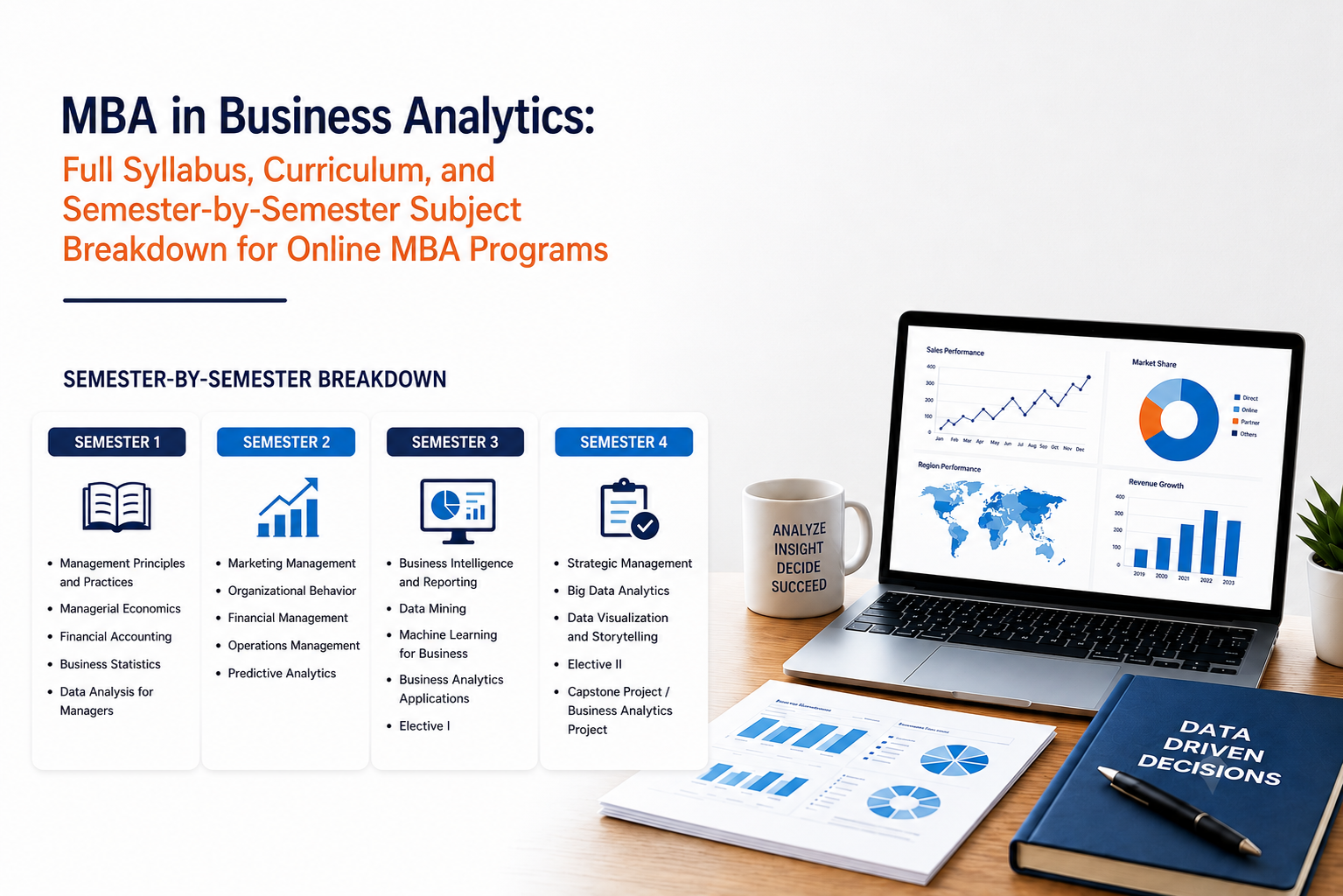
The MBA in Business Analytics is spread across 4 semesters, with each semester building on the last.
Semester 1: Business Foundations and Data Basics
| Subject | Focus Area |
| Statistics for Business | Descriptive and inferential statistics |
| Principles of Management | Management theories and practices |
| Business Communication | Professional writing and presentation |
| Managerial Economics | Demand, supply, and market analysis |
| Financial Accounting | Balance sheets, profit/loss statements |
| Introduction to Data Analytics | Basics of data types and data thinking |
Semester 2 Core Analytics Tools and Business Strategy
| Subject | Focus Area |
| Database Management Systems | SQL, data storage, and retrieval |
| Marketing Management | Consumer behavior, brand strategy |
| Business Intelligence Tools | Tableau, Power BI, dashboards |
| Operations Research | Optimization and decision models |
| Organizational Behavior | Team dynamics and leadership |
| Python/R for Data Analysis | Programming for data tasks |
Semester 3: Advanced Analytics and Specializations
| Subject | Focus Area |
| Machine Learning for Business | Predictive models, classification |
| Supply Chain Analytics | Inventory, logistics, and forecasting |
| Financial Analytics | Risk modeling, portfolio analysis |
| Digital Marketing Analytics | Campaign tracking, SEO metrics |
| HR Analytics | Workforce planning and performance data |
| Research Methodology | Quantitative and qualitative methods |
Semester 4: Application, Strategy, and Project Work
| Subject | Focus Area |
| Big Data and Cloud Computing | Hadoop, Spark, cloud platforms |
| Strategic Management | Long-term business planning |
| Entrepreneurship and Innovation | Building data-driven startups |
| Capstone Project / Dissertation | Real-world analytics problem-solving |
| Internship / Industry Project | Hands-on industry experience |
What Skills Will You Gain from This Program?
This MBA teaches both technical and soft skills, the combination that employers value most.
Technical Skills:
- Data visualization using Tableau and Power BI
- SQL and database querying
- Python or R programming for analytics
- Statistical modeling and forecasting
- Machine learning application in business
Business and Management Skills:
- Strategic decision-making
- Financial planning and analysis
- Marketing and consumer insight
- Leadership and team management
Soft Skills:
- Data storytelling and presentation
- Problem-solving under uncertainty
- Cross-functional communication
- Project management
What Are the Career Opportunities After This MBA?
Graduates of this program are hired across industries, from finance and healthcare to retail and technology.
Here are the top career roles:
- Business Analyst Analyzes data to help companies improve processes
- Data Analyst Works with datasets to find patterns and trends
- Marketing Analyst Tracks campaign performance and customer behavior
- Financial Analyst Models financial data to support investment decisions
- Product Analyst Monitors product usage and supports product teams
- Supply Chain Analyst Optimizes inventory and logistics using data
- BI Developer Builds dashboards and reporting tools
- Consultant (Analytics) Advises businesses on data strategy
Top hiring sectors include IT firms, banks, consulting companies, e-commerce platforms, FMCG brands, and healthcare organizations.
What Is the Salary Scope After an MBA in Business Analytics?
Salaries vary by role, location, and experience, but this field is one of the highest-paying MBA specializations.
| Experience Level | Approximate Salary (India) |
| Fresher (0–2 years) | ₹5–9 LPA |
| Mid-level (3–5 years) | ₹10–18 LPA |
| Senior (6+ years) | ₹20–40+ LPA |
For international roles or those working with a global education platform for cross-border skills certification, salaries can be significantly higher, especially in markets like the US, UK, UAE, and Singapore.
The demand for analytics professionals continues to grow, making this one of the most future-proof MBA specializations available
How Can You Apply? Admission Process Explained
Step-by-Step Admission Guide:
- Check eligibility Confirm you meet the academic requirements (50%+ in graduation)
- Appear for entrance exam, CAT, MAT, GMAT, or the university’s own test
- Submit application. Fill out the form online with academic documents and scores
- Group Discussion and Personal Interview (GD/PI) Most top schools include this round
- Receive admission offer Accept and pay the fees to confirm your seat
For online MBA programs, many universities skip the entrance exam and accept applications based on academic scores and work experience. This makes it more accessible for working professionals.
Key Takeaways
- An MBA in Business Analytics is a 2-year program combining management and data skills
- Eligibility: Bachelor’s degree in any stream with 50%+ marks
- The 4-semester curriculum covers statistics, Python, machine learning, BI tools, and strategic management
- Graduates can work as business analysts, data analysts, financial analysts, and consultants
- Starting salaries range from ₹5–9 LPA; senior professionals earn ₹20–40+ LPA
- Online MBA programs offer flexible admission and are ideal for working professionals
Conclusion
An MBA in Business Analytics is a smart choice for students who want to combine management skills with the power of data. The program prepares you for high-demand roles across a wide range of industries. Whether you choose a full-time or online path, the curriculum is designed to build both technical expertise and strong business acumen. ED Global Academy offers guidance to help aspiring professionals explore the right MBA options and make informed career decisions. If you are looking for a future-ready MBA that opens doors in data, strategy, and consulting, this is the right direction. Take the next step: explore programs, check eligibility, and begin your application today.
Frequently Asked Questions (FAQs)
1. What is an MBA in Business Analytics?
An MBA in Business Analytics is a two-year postgraduate management program that combines business administration with data analytics. It teaches students how to analyze business data, make informed decisions, and solve real-world business problems using analytical tools and techniques.
2. Who is eligible for an MBA in Business Analytics?
Candidates with a bachelor’s degree in any discipline from a recognized university, typically with at least 50% aggregate marks, are eligible. Some universities also require entrance exam scores such as CAT, MAT, XAT, or GMAT, while many online programs offer direct admission.
3. What subjects are included in the MBA in Business Analytics syllabus?
The syllabus generally includes Statistics for Business, Managerial Economics, Financial Accounting, Database Management Systems, Python or R Programming, Business Intelligence, Machine Learning, Financial Analytics, HR Analytics, Big Data, Strategic Management, and a Capstone Project or Internship.
4. Is an MBA in Business Analytics suitable for non-technical students?
Yes. Students from commerce, arts, science, engineering, and other academic backgrounds can pursue this program. Most universities begin with foundational concepts before introducing advanced analytics tools.
5. What skills will I gain from an MBA in business analytics?
Students develop technical skills such as SQL, Python, Tableau, Power BI, machine learning, and statistical analysis, along with business skills like strategic planning, leadership, financial analysis, decision-making, and communication.
6. What are the career opportunities after completing an MBA in business analytics?
Graduates can pursue roles such as business analyst, data analyst, marketing analyst, financial analyst, product analyst, business intelligence developer, supply chain analyst, and analytics consultant across industries including IT, banking, healthcare, retail, and e-commerce.
