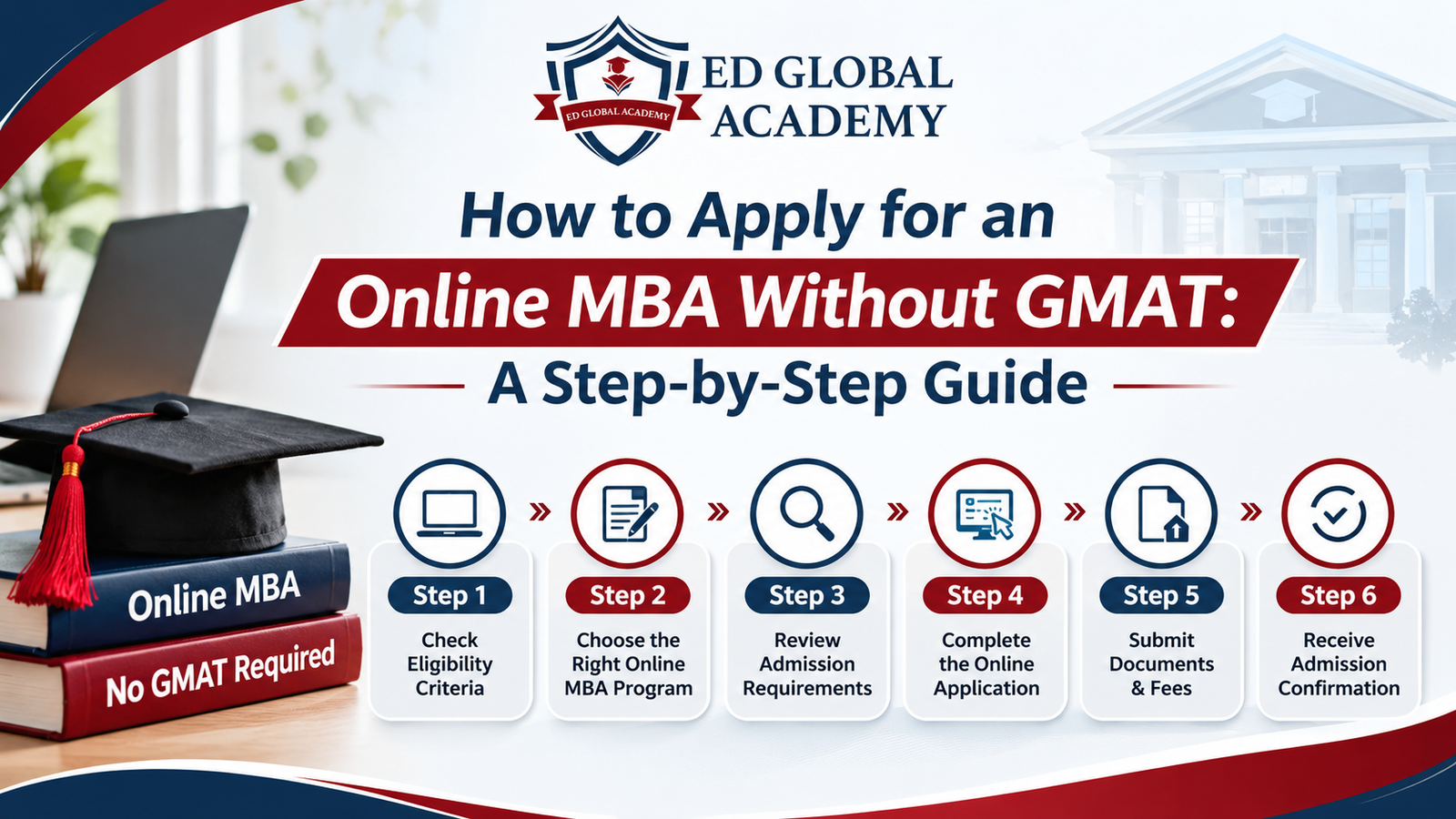
Many students give up on management studies the moment they hear the word GMAT. The good news is that an online MBA without GMAT is now common. Many universities admit students based on graduation marks, work experience, or a short interview.
This guide explains who can apply, the exact steps, the documents you need, and the career scope. It also covers mistakes to avoid. Read it before you pay any fee.
Before applying, it helps to understand the different admission requirements, program costs, and study options available. Read our online MBA program guide to learn what to compare before choosing a university.
What Is a No-GMAT Online MBA?
A no-GMAT online MBA is a two-year management degree taught through the internet, where the university does not ask for a GMAT score. Admission usually depends on your graduation marks, work experience, and sometimes an interview or a different entrance score such as CAT, MAT, or CMAT.
Classes are usually a mix of live sessions and recorded lectures. Exams may be online or at a test center, depending on the university.
Why do these programs skip the GMAT? Most are designed for working people who cannot spend months preparing for another exam. The degree has the same value as a regular MBA when the university is properly recognized.

Who Can Apply for an Online MBA Without GMAT Scores?
Most universities ask for a bachelor’s degree in any stream from a recognized university. Many want at least 50 percent marks, though some accept 45 percent. Work experience is often optional, but it can improve your chances at better programs. Final-year students can often apply provisionally.
Here is what most universities check:
- Graduation: Any stream, such as BA, BCom, BSc, BTech, or BBA.
- Minimum marks: Usually 45 to 50 percent, with relaxation for reserved categories.
- Work experience: Optional for most programs, but required for executive MBAs.
- Age: There is usually no upper age limit.
Rules differ from one university to another. Always confirm on the official website.
How to Apply: Step-by-Step Process
To apply, shortlist recognized universities, check eligibility, register on the official website, upload documents, pay the application fee, and wait for the offer letter. Then pay the program fee to confirm your seat. The whole process usually takes one to three weeks.
Follow these steps in order:
- Decide your goal. Do you want finance, marketing, HR, or business analytics? Your goal decides your specialization.
- Check recognition. In India, look for approval from UGC-DEB and, where relevant, AICTE. Verify it on their official websites. Do not rely on an agent’s word.
- Compare programs. Look at fees, specializations, exam mode, faculty, and student support.
- Read the admission criteria. Confirm that the university accepts students without a GMAT score.
- Register online. Create an account on the university’s official portal.
- Upload your documents. Use clear scanned copies.
- Pay the fee and confirm. Keep every receipt. Save your offer letter and student ID after admission.
Documents Required, Duration, and Subjects
You usually need your graduation marksheets, ID proof, passport photo, and a resume. A normal online MBA lasts two years, divided into four semesters. Some universities allow extra time to finish if work keeps you busy. Keep scanned copies ready before you start.
Common documents:
- 10th and 12th marksheets
- Graduation certificate and all semester marksheets
- Aadhaar, passport, or another government ID
- Passport-size photo and signature
- Resume and experience letter, if you have one
- Category certificate, if you claim relaxation
Subjects: The first year covers core topics like management principles, accounting, marketing basics, business statistics, economics, and organizational behavior. In the second year, you pick a specialization such as finance, HR, operations, marketing, or business analytics.
Skills you build: Communication, data handling, Excel, leadership, and time management. Employers value these more than the degree title.
Career Opportunities, Salary, and Future Scope
An online MBA can lead to roles in finance, marketing, HR, operations, and business analytics in private companies. Some government and public sector jobs also accept it if the degree is recognized. Salary depends more on your skills, experience, and city than on the degree model alone.
Your career options after an MBA depend on your specialization, previous experience, and the industry you want to enter. Explore our article on online MBA careers and salary potential to learn about common job roles and factors that influence pay.
Private Jobs
- Business analyst
- Marketing or sales executive
- HR executive
- Operations coordinator
- Relationship manager in banks and finance firms
Government Jobs
Some public sector banks, PSUs, and state departments hire MBA graduates for management roles. Teaching posts usually need UGC-NET as well. Read each job notification carefully, because rules about online degrees can differ.
Salary
No one can promise a fixed salary. Freshers often start modestly. Working professionals may see better growth through promotions. Your results depend on your skills, industry, and effort.
Future Scope and Higher Studies
Companies need managers who understand data, digital marketing, finance, and supply chains. After your MBA, you can also consider:
- Doctorate in Business Administration (DBA)
- PhD, if you like research
- Certifications such as CFA, PMP, or CMA
- UGC-NET, if you want to teach
Common Mistakes Students Make
The biggest mistake is choosing a university only because it is cheap or fast. Other common errors include skipping recognition checks, trusting agents blindly, ignoring hidden fees, and picking a specialization without a career goal. A little checking now can save two years of wasted effort.
Watch out for these:
- Not verifying approval. A good website does not prove a degree is valid.
- Ignoring the fee breakup. Ask about exam fees, study material, and re-exam charges.
- Expecting guaranteed placement. Placement help is support, not a promise.
- Underestimating self-study. No one will chase you to log in.
- Choosing a trending specialization. Pick what fits your strengths.

Who Should Choose It, Who Should Avoid It, and Tips
Choose it if you are working, need flexibility, and can study on your own. Avoid it if you want campus life, need constant classroom guidance, or hope the degree alone will get you a job. Check recognition, fees, and support before you pay anything.
Good fit for:
- Working professionals who want a promotion or career switch
- Graduates who cannot relocate for a campus MBA
- Students who are disciplined and comfortable with online tools
Think twice if you:
- Need a strict classroom routine to stay motivated
- Want a top campus brand and its alumni network
- Cannot spend fixed hours each week on study
Practical tips:
- Talk to current students or alumni.
- Ask for the full fee breakup in writing.
- Attend a demo class and check the learning portal.
- Read the exam and attendance rules.
- Set fixed study hours each week from day one.
Key Takeaways
- Many universities offer an online MBA without a GMAT score and admit students through graduation marks, experience, or an interview.
- Most programs need a bachelor’s degree with about 45 to 50 percent marks.
- Always verify UGC-DEB or AICTE recognition on official websites.
- The usual duration is two years across four semesters.
- Careers and salary depend on your skills and experience, not only the degree.
- Check fees, support, and exam rules before you pay.
Conclusion
A GMAT score is not the only way into management education. If you meet the eligibility, choose a recognized university, and stay consistent, an online MBA can be a practical step in your career.
Compare at least three programs before deciding. If you want help comparing options, ED Global Academy, a global education platform, is one place where you can ask questions. Whatever you choose, confirm recognition yourself on the official websites.
FAQs
- How long does an online MBA take?
Usually two years, split into four semesters. Some universities allow extra time to finish. - What are the fees?
They vary widely by university. Ask for the full breakup, including exam and material charges. - Is it difficult?
It is manageable if you study regularly. The main challenge is self-discipline, not the subjects. - Can I get a job after it?
Yes, but it depends on your skills, experience, and effort. The degree helps, but it does not guarantee a job. - What is the salary after an online MBA?
There is no fixed figure. Pay depends on your industry, city, skills, and experience.
