Choosing among the hundreds of MBA courses offered across American business schools can feel overwhelming, especially with admissions policies, costs, and rankings shifting every year. Whether you’re a working professional considering a part-time program or a recent graduate eyeing an elite full-time seat, the decisions you make now will shape your career for years to come.
This guide breaks down everything you need to know about MBA courses in the USA for 2026: how the top programs stack up, what they cost, how admissions requirements are changing, and what alternatives exist if you’d rather build your business foundation through a flexible global education platform before (or instead of) committing to a full MBA.
Why Consider MBA Courses in the USA
The United States remains home to the largest concentration of highly regarded business schools in the world, and international interest hasn’t cooled. <cite index=”12-1″>Roughly 20 to 50 percent of a typical American MBA class is made up of international students, and international applicants account for around 40 percent of all MBA applications in the US. </cite>
That said, competition and costs are both rising, which makes it important to go in with a clear strategy rather than simply chasing a brand name.

Key benefits of studying MBA courses in the USA:
- Access to globally recognized faculty and research
- Strong on-campus recruiting pipelines into consulting, finance, and tech
- Large, diverse alumni networks spanning nearly every industry
- Flexible format: full-time, part-time, executive, and online to fit different career stages
Top MBA Programs in the USA for 2026
Rankings vary depending on the methodology, but a consistent group of schools often called the “M7” continues to dominate most lists.
<cite index=”5-1″>The M7 group consists of Booth, Columbia, Harvard, Kellogg, MIT Sloan, Stanford, and Wharton. </cite> Beyond the M7, several other well-regarded programs consistently place in the top 10 to 15 nationally.
| Ranking Source | Notable 2026 Standout |
| Financial Times Global MBA Ranking 2026 | <cite index=”1-1″>MIT Sloan ranks as the best MBA program in the US</cite> |
| QS Global MBA Rankings 2026 | <cite index=”3-1″>Wharton is ranked as the best full-time MBA in the US</cite> |
| Poets&Quants 2025-2026 Composite | <cite index=”4-1″>Northwestern’s Kellogg finishes No. 1 for the second year in a row, with Harvard rising to No. 2</cite> |
| US News & World Report 2026 | Stanford, Wharton, Booth, Harvard, and Kellogg lead the national list |
Each ranking weighs factors like employment outcomes, salary uplift, and research output differently, so it’s worth comparing at least two or three sources rather than relying on a single list.
School specializations worth noting
<cite index=”5-1″>Columbia leads in accounting, MIT Sloan leads in analytics, entrepreneurship, production operations, and supply chain logistics, Stanford leads in finance, and Wharton leads in management, marketing, and real estate</cite>, according to US News & World Report’s subject-area breakdowns. If you already know the function you want to specialize in, this kind of granular data can matter more than the overall rank.
Types of MBA Courses Available in the USA
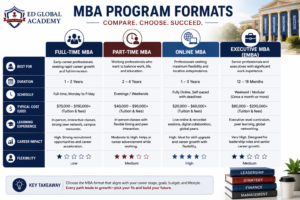
Not every applicant needs or can commit to a traditional two-year, full-time program. American business schools offer several formats:
1. Full-Time MBA
The traditional two-year format, ideal for career switchers who want deep immersion, internships, and full access to campus recruiting.
2. Part-Time MBA
Designed for working professionals who want to keep their job while studying evenings or weekends.
3. Executive MBA (EMBA)
Built for mid-to-senior career professionals, typically with 8+ years of experience, and often completed in cohorts over 18-24 months.
4. Online MBA
Increasingly popular for its flexibility and often lower cost. <cite index=”10-1″>A growing number of online MBA programs are dropping GMAT requirements to streamline admissions and attract experienced professionals</cite>.
5. One-Year MBA
A compressed, intensive option for candidates who already have a strong business background and want to minimize time out of the workforce.
Cost of MBA Courses in the USA
Tuition varies enormously depending on the type of program and school prestige.
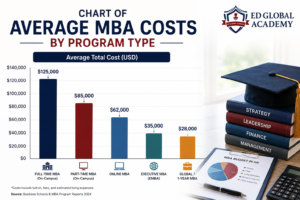
- Elite full-time MBAs (M7 and similar): Often exceed $150,000-$200,000 in total cost once living expenses are included
- Online MBAs: <cite index=”11-1″>Some programs run around $32,000 in total tuition, while more affordable options can come in near $13,000</cite>
- State school and public university MBAs: Generally fall in the middle, often more affordable for in-state residents
Before committing to any program, it’s worth running a realistic return-on-investment calculation, factoring in tuition, lost income during full-time study, and expected salary growth after graduation.
Admissions Trends for 2026
MBA admissions policies have shifted noticeably over the past few cycles, and 2026 applicants should pay close attention to a few key trends:
- Testing requirements are diverging. <cite index=”15-1″>For the 2026 intake, programs like NYU Stern, UVA Darden, Michigan Ross, UCLA Anderson, UT Austin McCombs, and USC Marshall continue to offer GMAT waivers or test-optional paths, while most traditional M7 schools have returned to mandatory testing. </cite>
- The Data Insights section matters more. <cite index=”16-1″>Admissions officers increasingly view the GMAT’s Data Insights score as a proxy for a candidate’s ability to work in a data-driven environment, so a strong overall score paired with a weak DI percentile can raise concerns. </cite>
- International applicant demographics are shifting. <cite index=”14-1″>Domestic US applications are declining while South Asian applicant volume is rising quickly, changing the competitive landscape for many programs. </cite>
- Test-optional is largely a domestic phenomenon. <cite index=”14-1″>International applicants overwhelmingly still submit a test score even where policies allow otherwise. </cite>
What this means for applicants
If you’re an international applicant, plan to sit for the GMAT or GRE regardless of a school’s official policy, since most successful international admits still submit a competitive score. If you’re applying to a non-M7 program with a waiver option, weigh whether skipping the test truly strengthens or weakens your file.
Building the Right Foundation Before an MBA
Not everyone needs to jump straight into a full MBA program. If you’re still exploring whether business school is the right move or you want to sharpen core skills like financial modeling, strategy, or leadership before applying, structured pre-MBA learning can make a real difference in both your application and your eventual coursework.
This is where a global education platform like ED Global Academy can help candidates build foundational business knowledge, strengthen their profile with relevant coursework, and approach MBA applications with more clarity and confidence.
How to Choose the Right MBA Program
With so many MBA courses available, narrowing down your options comes down to a few core questions:
- What’s your career goal? Consulting, finance, tech, and entrepreneurship each favor different schools and specializations.
- What format fits your life right now? Full-time immersion, part-time flexibility, or online convenience.
- What can you realistically afford? Include opportunity cost, not just tuition.
- Where do you want to work after graduation? Regional employer networks matter more than most applicants expect.
- Do you need a test score waiver, or should you prepare for the GMAT/GRE regardless?
Conclusion
Choosing among the many MBA courses available in the USA in 2026 comes down to matching your career goals, budget, and lifestyle with the right program format and school. Testing requirements, costs, and applicant demographics are all shifting, so staying current on these trends will help you apply strategically rather than simply chasing rankings.
If you’re still building your foundation before taking the leap, exploring resources through a global education platform can help you enter the MBA admissions process with more clarity, stronger skills, and a more competitive application.
Frequently Asked Questions
What are the best MBA courses in the USA for 2026?
Programs at Wharton, MIT Sloan, Harvard, Kellogg, Booth, Stanford, and Columbia consistently rank among the top choices, though the exact order shifts depending on the ranking methodology used.
Do I need the GMAT for MBA courses in the USA?
It depends on the school. Several programs offer GMAT waivers or test-optional admissions, but most elite full-time programs still require a competitive score, and international applicants are strongly encouraged to submit one regardless of official policy.
How much do MBA courses in the USA cost?
Costs range widely, from around $13,000 for some online programs to well over $150,000 for elite full-time programs once living expenses are factored in.
Can international students apply for MBA courses in the USA?
Yes. International students make up a significant share of most American MBA cohorts, and many programs actively recruit global talent.
What’s the difference between a full-time and executive MBA?
A full-time MBA is typically a two-year, immersive program for career switchers, while an executive MBA is designed for experienced professionals who continue working while studying, usually in a compressed schedule.
