
Many students hear about honorary doctorates and wonder if they are a shortcut to a “Dr.” title. They are not. An honorary doctorate is a rare award for people who have already done outstanding work. This guide explains how that honor works, what institutions look for, and what it will and will not do for your career. If you are building your path toward honorary doctorate recognition, start with the facts below.
What Is an Honorary Doctorate and Why Is It Given?
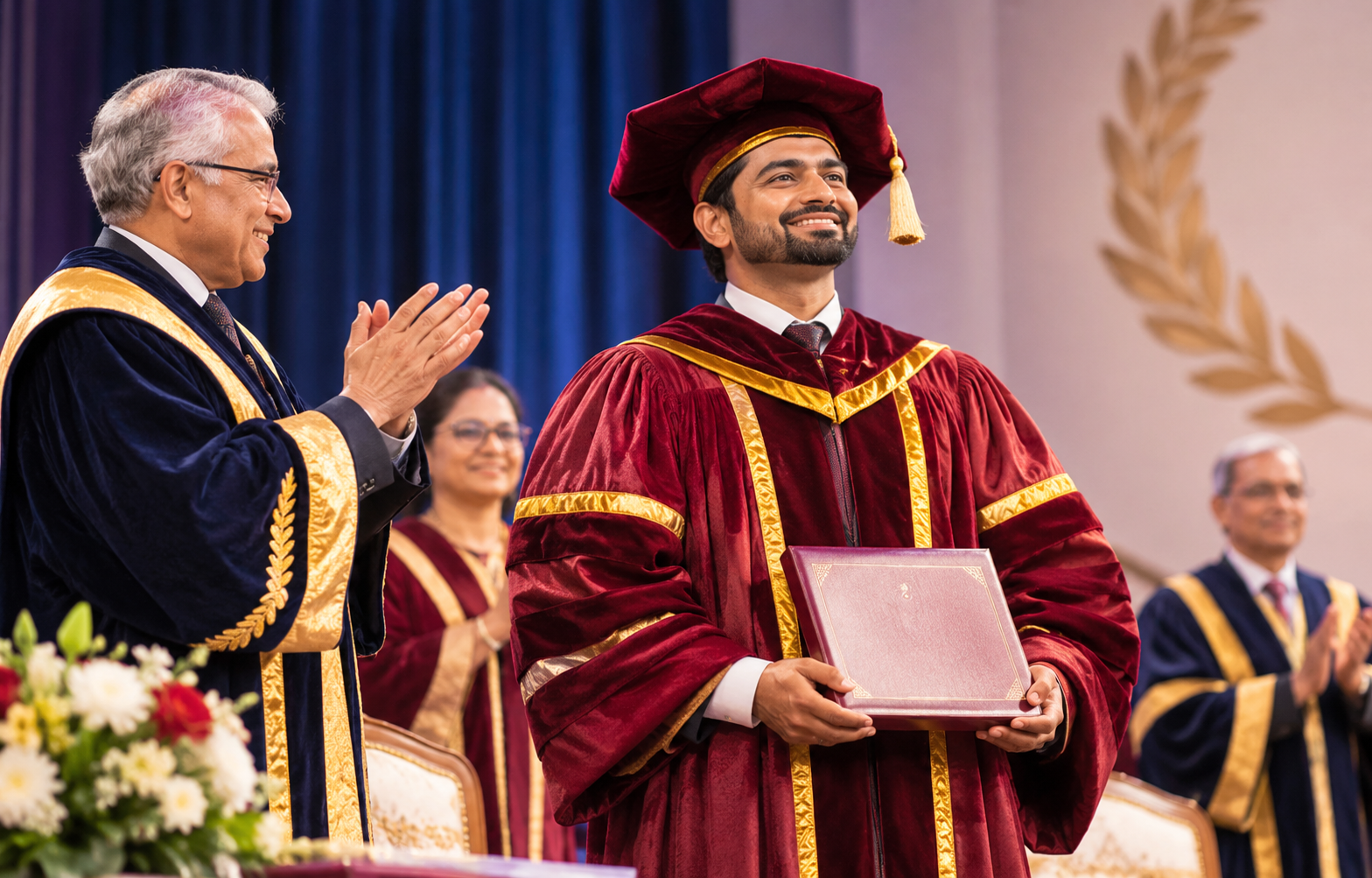
An honorary doctorate is a degree-style title awarded by a university or recognized institution to honor a person’s outstanding work. It is given for contribution, not for study or exams. Recipients do not attend classes or write a thesis, and the title does not replace an earned PhD.
Universities give it to thank people who have added real value to society. That could be a teacher who trained thousands of students, a scientist, an entrepreneur, or a social worker.
Think of it as a thank-you from the academic world, not a course you can enroll in. To understand the difference between an honorary award and an academically earned qualification, read our guide on honorary doctorate vs. doctorate

Who Can Receive an Honorary Doctorate?
There is no fixed eligibility like a degree course. Institutions usually look for people with long, proven work in a field such as education, business, science, arts, or social service. Most recipients have many years of experience and clear public impact, so fresh graduates rarely qualify.
Here is what selection committees usually look for:
- A long and consistent record in one field
- Work that helped people, a community, or an industry
- A good public reputation and honest conduct
- Proof of achievements, such as records, awards, or published work
- A nomination from a respected person or organization
Eligibility requirements can differ between awarding institutions. Read our detailed article on honorary doctorate criteria to understand the achievements and contributions commonly considered during selection.
10 Practical Ways to Build a Strong Profile for an Honorary Doctorate
You earn this honor by building a strong, documented record of impact in your field. The best routes include long-term leadership, innovation, teaching, research, and social service. Start by keeping proof of your work, because every nomination depends on evidence.
- Build deep expertise. Stay in one field for many years and become someone others trust.
- Lead with results. Manage projects or organizations where you can show real outcomes.
- Create original work. Write, research, design, or invent something others can use.
- Teach and mentor. Guiding students and young professionals is valued highly.
- Serve society. Community work, health camps, and literacy drives all count.
- Create opportunities. Starting a business that gives people jobs is real impact.
- Earn credible awards. Recognition from known professional bodies adds weight.
- Join professional bodies. Speak at conferences and contribute to your industry.
- Document everything. Keep a clean portfolio with your CV, press coverage, letters, and proof of results.
- Get nominated by credible people. A nomination from respected peers or institutions matters more than applying for yourself.
Notice that none of these can be completed in a year. This is a long-term path.
What Does an Honorary Doctorate Mean for Your Career?
It adds prestige and credibility, but it does not work like an earned degree. It does not make you eligible for academic posts, government jobs, or admission to higher studies. It is respect for past work, not a qualification for a future job.
Here is the realistic picture:
- Government jobs: Recruitment rules ask for earned degrees, so this title will not count.
- Private jobs: Employers care about skills and results. The title may add some trust, but it will not replace experience.
- Salary: There is no direct pay benefit.
- Higher studies: It cannot be used as a PhD or any admission qualification.
- Using “Dr.”: Some education bodies advise against using “Dr.” before your name for an honorary title. Check the rules in your country before doing so.
Common Mistakes Students Make
The most common mistake is treating an honorary doctorate as a quick credential. Students often confuse it with a real PhD, pay for offers that sound too good to be true, or chase the title before building any real work record.
Avoid these errors:
- Believing it can replace an earned doctorate
- Paying a “processing fee” or “award fee” to get the title
- Applying with no portfolio or proof of work
- Ignoring whether the institution is recognized
- Listing it on a CV in a misleading way
- Expecting a job or salary jump after receiving it
Who Should Aim for It and Who Should Avoid It
This honor suits experienced professionals with a long record of public contribution. It does not suit students who want a career qualification, a teaching job, or a research path. For those goals, an earned degree is the right choice.
Who should aim for it:
- Professionals with many years of proven work
- Teachers, founders, and social workers with visible impact
- People who already have a documented record of achievements
Who should avoid it:
- Students looking for a quick “Dr.” title
- Anyone who wants to become a professor or researcher
- Anyone asked to pay money in return for the title
If you are early in your career, a better goal is to build skills, get your degree, and let your work speak. Recognition often follows good work.
How to Check If an Honorary Doctorate Offer Is Genuine
Before accepting any offer, confirm that the institution is recognized and that the selection process is open and merit-based. A genuine honor is given for your work, not sold for a fee. Verify everything in writing before you reply.
Follow these steps:
- Check the institution’s recognition on the official website of your country’s education regulator.
- Look for a clear nomination and selection process.
- Read past recipients’ names and confirm they are real, well-known people.
- Be careful if anyone asks for payment to “release” the title.
- Avoid offers that arrive with pressure or tight deadlines.
- Ask for the award criteria in writing.
When in doubt, speak to a mentor or a trusted education counsellor first.
Key Takeaways
- An honorary doctorate honors past achievements and is not a study program.
- It does not replace a PhD or any earned degree.
- It does not give you eligibility for government jobs or higher studies.
- Long-term, documented impact is the base of a strong profile.
- A genuine honor is never sold, so be careful with offers asking for fees.
- Students should focus on skills and education first and recognition later.
Conclusion
An honorary doctorate is a meaningful honor, but it is a result of years of good work, not a starting point for your career. Focus on learning, building real skills, and creating value in your field. Keep records of what you achieve, and treat any offer with care until you have checked it. If you want guidance on recognition and academic pathways, ED Global Academy is one Global Education Platform where you can explore such options with an informed mindset.
FAQs
- How long does it take to get an honorary doctorate?
There is no fixed duration. Most recipients have spent many years building their careers before being honored. - What is the fee for an honorary doctorate?
A genuine honor does not require payment for the title. If an offer demands a fee, treat it as a warning sign and verify it. - Is it difficult to receive one?
Yes, it can be. Institutions look for strong, proven impact, and the selection is usually competitive. - Can an honorary doctorate help me get a job?
It may add some trust with certain employers. It will not replace skills, experience, or an earned degree. - Does it increase salary?
There is no direct salary benefit. Pay depends on your skills, role, and experience. - Can I use it for higher studies or a PhD?
No. It is not an academic qualification, so it cannot be used for admissions.
