
If you’re weighing up a Doctor of Business Administration (DBA), the question that usually comes before “Which program?” is simpler: What does a DBA salary actually look like once you’ve got the letters after your name?
It’s a fair question, because a DBA is a serious investment of time and money. This guide breaks down what current data says about DBA salary in the UK and internationally, how pay differs by industry and seniority, how a DBA compares to a PhD or MBA financially, and whether the return on investment stacks up. Wherever we cite a figure, it’s sourced from a named provider, not invented numbers.
What Is a DBA, and Why Does It Command a Premium?
A doctor of business administration is a terminal degree, the highest academic qualification in business, on the same level as a Ph.D. but built for working executives rather than academic researchers. Where a PhD in business is theory- and research-first, a DBA is applied: candidates use doctoral-level research methods to solve real problems inside their own organizations, usually while continuing to work full time.
That practical, executive-facing orientation is exactly why DBA holders tend to out-earn peers with a standard MBA or an undergraduate business degree. The credential signals both advanced strategic thinking and applied research skills, a combination employers pay for in consulting, corporate leadership, and academia alike.
Average DBA Salary: What the Data Shows
There’s no single official UK government wage survey that isolates “DBA holders” as a category, so the most reliable numbers come from a mix of institutional reporting and salary data providers, alongside comparable US figures (used globally as the benchmark reference point since DBA salary data is the most robust there).
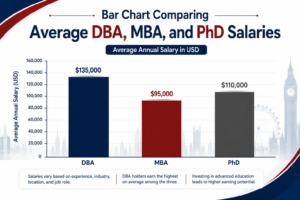
- UK providers such as the London School of Business & Finance (LSBF) report that a DBA can push a graduate’s earning potential beyond £100,000 and note the degree typically carries a 15–30% salary premium over an MBA, whose holders more often plateau in the mid-£70,000s in management roles.
- In the US, where DBA salary data is most granular, Research.com puts the 2026 average DBA salary at roughly $120,000–$150,000, varying by industry, location, and experience.
- Drilling into role-level data from Payscale, cited by Research.com, business consultants average $82,633, business executives average $81,708 (with top earners reaching $345,000), and general business administrators average $62,059.
- A separate industry roundup puts US DBA holders’ typical range at $90,000–$300,000+, with median advertised salaries around $144,500 in corporate and consulting roles, and C-suite titles like CEO commanding $206,000–$300,000.
The consistent theme: base pay for a DBA holder in a generalist role sits well above the UK’s overall graduate average, but the real financial upside comes from the roles the degree unlocks: consulting partner, C-suite executive, or senior academic, rather than the letters themselves.
DBA Salary by Industry
| Industry | Typical Roles for DBA Holders | Pay Positioning |
| Consulting | Management consultant, strategy director | Among the highest-paying paths, premium consulting firms pay well above generalist averages |
| Corporate / C-suite | CEO, COO, CFO, corporate strategy director | The highest ceiling US data from the Bureau of Labor Statistics (BLS) puts the mean annual wage for top executives at $258,900 |
| Academia | Business school professor, senior lecturer | Lower base pay than industry roles, but strong job security and prestige; a DBA is often the entry credential for professorship tracks |
| Healthcare management | Healthcare executive, hospital administrator | Growing demand for doctorate-level strategic leadership in complex health systems |
| Technology | VP of operations, chief strategy officer | Increasingly common path as tech firms hire DBA holders for scaled operational leadership |
Management analysts and consultants, a common landing spot for new DBA graduates, earn a median wage of around $99,410, according to Lightcast data reported by Franklin University, with considerably higher pay available in specialized or boutique consulting firms.
DBA Salary by Experience and Seniority
Salary progression for DBA holders tends to follow a familiar shape but from a higher starting point than most terminal degrees:
- Early career (0–3 years post-DBA): Typically transitioning from a senior manager or director role into a stretch leadership position; pay often reflects the pre-DBA role with a step up.
- Mid-career (4–10 years): This is where the DBA premium becomes most visible; candidates move into director, VP, or partner-track consulting roles.
- Senior/executive (10+ years): C-suite and top-tier consulting partner roles, where total compensation (including bonus and equity) can exceed $300,000 in the US market and comfortably clear £150,000+ in UK corporate settings.
Because so many DBA candidates are already mid-to-senior professionals when they enroll, the degree tends to accelerate an existing trajectory rather than start one from scratch.
DBA Salary by Region
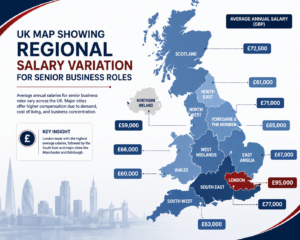
Geography still matters. In the UK, London and the South East command a premium over the national average for senior business roles, reflecting both cost of living and concentration of head office and consulting jobs. Regional UK cities Manchester, Birmingham, Leeds, and Edinburgh trail London but still outperform the national graduate average once a DBA holder reaches director level.
Internationally, North America remains the highest-paying market for DBA holders, particularly in legal and corporate and consulting sectors, followed by parts of Western Europe and the Gulf, where multinational corporate and consulting demand is strong.
DBA vs PhD vs MBA: Salary Comparison
| Degree | Focus | Typical Salary Positioning |
| MBA | General management, broad business skills | Solid but often plateaus; US average around $74,500, with UK management roles often capping in the mid-£70,000s |
| PhD (Business) | Academic, theory- and research-first | Strong in academia, but industry roles pay less consistently than DBA/MBA holders in executive tracks |
| DBA | Applied, executive-level, doctoral research | Highest ceiling among the three for senior industry roles; carries a reported 15–30% premium over MBA pay, plus the professional credibility of the “Doctor” title |
Both DBA and PhD graduates can use the title “Dr.” since both are doctoral-level qualifications, but DBA holders more consistently translate that credential into higher industry pay, given the degree’s built-in orientation toward leadership and applied business problems rather than pure research.
Is a DBA Worth It? ROI vs. Program Cost
A DBA is a significant financial commitment. UK and international programs commonly run from the low tens of thousands of pounds up to £50,000+, depending on the institution and format (full residential vs. executive/part-time). Weighing that against the earning data above:
- If a DBA supports a move into a C-suite or senior consulting role, the salary uplift can recoup program costs within a few years.
- If the goal is academia, ROI is slower in pure salary terms but strong in career stability, prestige, and long-term earning security.
- If a candidate is already senior and the DBA is used mainly for credibility and a lateral move, ROI is harder to quantify but often shows up in promotion speed and negotiating leverage rather than an immediate pay jump.
For working professionals comparing providers, it’s worth looking beyond the marketing headline salary figures and checking a program’s specific graduate outcomes, accreditation, and alumni career paths. Global education platforms such as ED Global Academy are among the resources professionals use to compare doctoral-level business programs and career-focused courses before committing to one.
Conclusion
There’s no single number that captures “the” DBA salary; pay depends heavily on industry, seniority, location, and the role the degree is used to unlock. But the pattern across UK and international data is consistent: DBA holders in consulting, corporate leadership, and senior academic roles out-earn MBA and bachelor’s-level peers by a meaningful margin, with reported premiums of 15–30% over MBA pay and UK earning potential commonly clearing £100,000 in senior roles.
If you’re evaluating whether a DBA fits your career plans, look past the headline averages: check a program’s actual graduate outcomes, weigh the cost against your realistic career trajectory, and compare providers’ resources. ED Global Academy can help with that groundwork before committing to a doctoral-level investment.
Frequently Asked Questions
What is the average DBA salary?
US-based data from Research.com puts the 2026 average around $120,000–$150,000, while UK sources such as LSBF report DBA holders commonly clearing £100,000, with a reported 15–30% premium over MBA pay.
Is a DBA worth it financially?
For candidates moving into C-suite, senior consulting, or specialist academic roles, yes, the salary ceiling is meaningfully higher than an MBA or bachelor’s-level business qualification. ROI is strongest when the degree unlocks a specific senior role rather than being pursued for the credential alone.
Do DBA holders earn more than MBA holders?
Generally, yes. Reported figures put the DBA premium at 15–30% over MBA pay, since MBA-holder salaries tend to plateau in management roles while DBA holders progress into executive and partner-level positions.
What jobs can I get with a DBA?
Common paths include CEO and other C-suite roles, management consultant, corporate strategy director, business school professor, and senior business analyst.
How does DBA salary vary by industry?
Consulting and corporate C-suite roles offer the highest ceilings. BLS data puts top executive mean pay at $258,900 in the US, while academia offers lower base pay but strong job security and prestige.
