
Finishing a doctorate is a major achievement, but the next question is often the hardest: what comes after? Many people assume a PhD leads only to a professor’s desk. In reality, the skills you build in a PhD program open doors across universities, industry, government, healthcare, technology, and business.
This guide walks through the top career opportunities after a PhD degree, what each path involves, and how to choose the one that fits your goals.
What Can You Do After a PhD?
After a PhD, you can work in teaching, research, government science roles, private industry, consulting, or policy or start your own venture. A doctorate trains you to solve hard problems using evidence, so many fields value it. Your best path depends on your subject, skills, and interests.
Think of your PhD as proof of three things: you can research deeply, you can finish long projects, and you can think independently. Employers in every sector want these abilities.

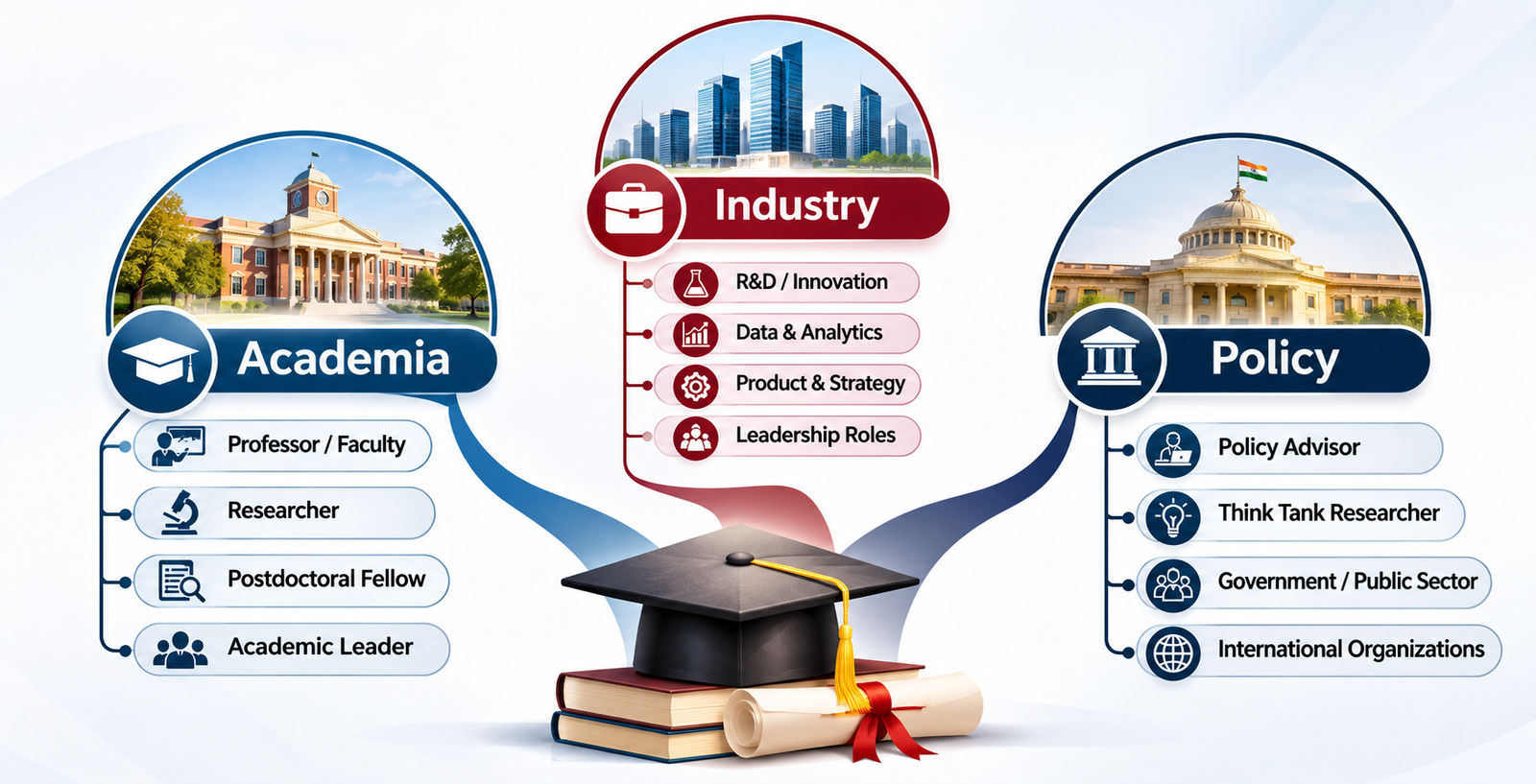
Career Opportunities in Academia and Research
The most common path is academic work: assistant professor, postdoctoral researcher, or research fellow. These roles suit people who love teaching and publishing. Competition is high, so a strong publication record matters a lot.
Common academic roles:
- Assistant Professor at a university or college
- Postdoctoral Fellow (usually 2–3 years of research)
- Research Associate or Senior Research Fellow
- Lecturer at private institutes
A postdoc is often a stepping stone, not a final job. Plan for it, but also keep a backup plan.
Government Jobs After a PhD
Government jobs for PhD holders are mostly in research and science. They offer stability and a clear career ladder, though selection is competitive and recruitment cycles can be slow.
Options to explore:
- Scientist posts in CSIR, DRDO, ISRO, ICAR, and similar bodies
- Research roles in government departments and policy institutes
- University faculty posts in public institutions
- Civil services (a PhD helps your knowledge, but the exam is open to all graduates)
Always check eligibility rules and recent notifications on official websites, because requirements change.
Private Sector and Industry Jobs
Companies hire PhD holders for research, product development, and data-heavy decisions. This is the fastest-growing area for doctorate holders. Pay is usually higher than in academia, but the work is more focused on business results.
Where PhDs work in industry:
- R&D labs in pharma, biotech, chemicals, and engineering
- Data science and machine learning teams
- Technology companies and startups
- Consulting and market research firms
- Education companies, as curriculum designers or subject experts
- Finance and analytics roles
A sociology or economics PhD, for example, can move into policy research or user research. A chemistry PhD may join a pharma company.
How Much Can You Earn After a PhD?
Salary after a PhD varies widely by subject, country, sector, and experience. In general, industry roles pay more than academic or government roles at the start. Academic salaries grow slowly but come with job security and research freedom.
Factors that affect your pay:
- Your field (science and technology often pays more)
- Publications and patents
- Practical or industry experience
- Location and employer type
- Communication and leadership skills
Be careful with promises of “guaranteed high salary.” A PhD improves your chances, but it does not guarantee a number.
Skills Employers Expect from PhD Holders
Employers want more than a degree. They look for what you can actually do. A PhD gives you strong research ability, but you must show other skills too.
Skills that help you get hired:
- Clear writing and presentation
- Data analysis and basic coding
- Project management and meeting deadlines
- Teamwork and mentoring
- Explaining complex ideas in simple words
- Grant writing, for research careers
Start building these during your research years. Attend workshops, join collaborations, and try small industry projects.
Common Mistakes to Avoid After a PhD
The biggest mistake is waiting until submission to think about your career. Others include applying only for academic jobs, ignoring networking, and having a resume that reads like a long research paper.
Avoid these errors:
- Starting late. Begin career planning in your final year, or earlier.
- Using an academic CV for industry jobs. Employers want a short resume focused on results.
- Undervaluing yourself. Your skills apply beyond your thesis topic.
- Skipping networking. Many roles are filled through contacts and referrals.
- Chasing only one outcome. Keep two or three paths open.
Who Should Choose a PhD, and Who Should Avoid It?
A PhD suits people who are curious, patient, and enjoy solving open-ended problems. It is a poor fit if you want it only for a title, a quick salary jump, or because you are unsure what else to do.
Choose it if:
- You enjoy research and reading deeply
- You want a career in teaching, science, or R&D
- You can handle slow progress and setbacks
Avoid it if:
- You want fast earnings
- You dislike independent, self-driven work
- You are doing it only to delay job decisions
Tips before joining a PhD program:
- Talk to current scholars about their real experience.
- Check your supervisor’s track record and support.
- Confirm funding and fellowship options.
- Ask where past graduates are working now.
Key Takeaways
- A PhD opens paths in academia, government, industry, consulting, and entrepreneurship.
- Academic jobs are competitive, so keep a backup plan.
- Industry roles often pay more but focus on business results.
- Skills like writing, data analysis, and communication matter as much as research.
- Start career planning early, not after submission.
- Choose a PhD for genuine interest, not only for pay or status.
Conclusion
A doctorate prepares you for much more than a faculty post. From industry research and data science to consulting, policy, healthcare, entrepreneurship, and writing, the career opportunities after a PhD are broad and growing. The best choice depends on your strengths, interests, and willingness to keep learning.
If you are planning your next step, explore learning and recognition resources from ED Global Academy, a global education platform for scholars and professionals. Start by choosing two paths from this list, speak with people working in them, and build the skills they ask for.
Frequently asked questions
Is a PhD worth it for a career outside academia?
Yes, if your target field values deep expertise or research skills, such as R&D, data science, consulting, or policy. Check whether your chosen role actually requires a doctorate before committing.
What is the most common job after a PhD?
Many graduates start with a postdoctoral position or move into industry research. The mix varies by field, so look at graduate outcome data from your own department.
Do I need a postdoc after my PhD?
Not always. A postdoc is usually expected for academic careers, but many industry, government, and consulting roles hire directly after the doctorate.
Can PhD holders become entrepreneurs?
Yes. Many turn research, patents, or specialist knowledge into startups or consulting businesses. Support from incubators and mentors can help.
Do PhD holders earn more?
Often, but not always. Pay depends on the field, sector, country, and role. Review salary data from reliable national or professional sources before making decisions.
How do I choose a good PhD program?
Look at the supervisor’s research record, funding, lab resources, graduate outcomes, and how well the work matches the career you want.
