Data now drives decisions in almost every industry, from healthcare and finance to retail and logistics. That demand is why so many working professionals and recent graduates are choosing an MSc Data Science online program. It lets them upskill without pausing their careers or relocating.
But what do you actually learn? A good program goes well beyond teaching you to write code. It builds a layered skill set that combines technical depth, statistical thinking, business sense, and the habits of a self-directed professional.
This guide walks through the top skills you develop during an online data science master’s, why each matters to employers, and how to make the most of them.
To understand the different roles and industries in this field, explore these data science and AI career opportunities
What skills do you build in an online data science master’s?
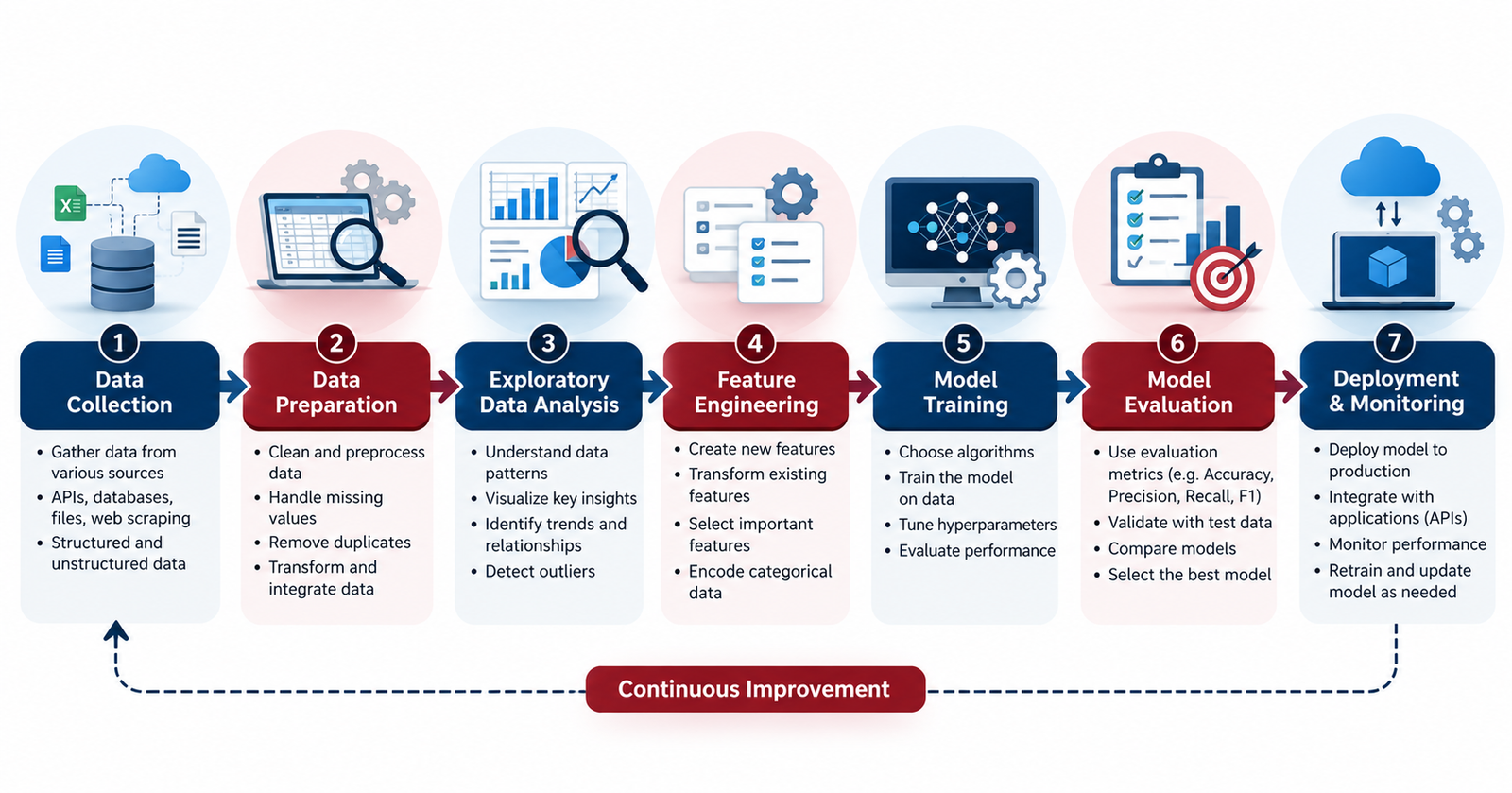
An online data science master’s builds four groups of skills: programming, statistics, machine learning, and communication. You learn to collect data, clean it, find patterns, build prediction models, and explain results to people who are not technical. Most programs also teach self-discipline, which online learners need every week.
Most universities ask for a bachelor’s degree, often with math or statistics in some form. The course usually runs for two years. Rules differ between universities, so read each eligibility page carefully.
Read also: Career Scope of Artificial Intelligence and Data Science in the USA
Core Technical Skills
1. Programming for Data Science
Almost every data science role requires fluency in at least one programming language. Most programs focus on:
- Python for data manipulation, machine learning, and automation
- R for statistical analysis and visualization
- SQL for querying and managing relational databases
You will typically learn to write clean, reusable code, work with libraries such as pandas, NumPy, and scikit-learn, and use version control tools like Git.
2. Data Wrangling and Preprocessing
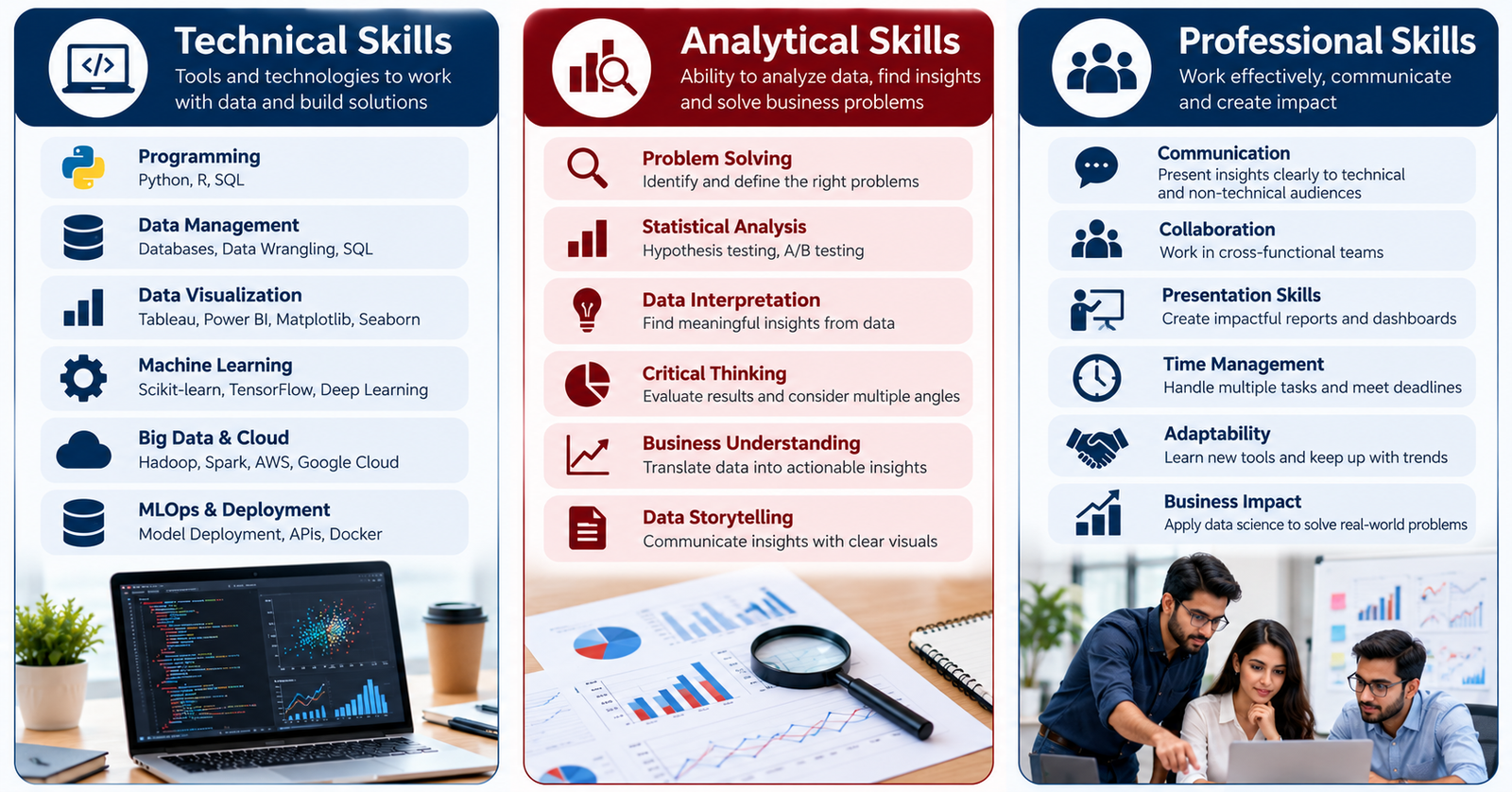
Real-world data is rarely tidy. A large share of any data scientist’s time goes into preparing data before analysis begins.
In your coursework, you practice:
- Handling missing and inconsistent values
- Detecting and treating outliers
- Merging data from multiple sources
- Transforming and scaling features
- Building repeatable data pipelines
This skill alone separates job-ready graduates from people who have only worked with clean textbook datasets.
3. Statistics and Probability
Statistics is the foundation under every model you build. Online master’s programs usually cover:
- Descriptive and inferential statistics
- Hypothesis testing and confidence intervals
- Regression analysis
- Bayesian thinking
- Experimental design and A/B testing
A solid grounding here helps you avoid common traps, such as mistaking correlation for causation or trusting results from a biased sample.
4. Machine Learning
Machine learning is usually the centerpiece of the degree. You learn how algorithms find patterns in data and make predictions.
Typical topics include:
- Supervised learning (regression, classification, decision trees, ensemble methods)
- Unsupervised learning (clustering, dimensionality reduction)
- Model evaluation, cross-validation, and hyperparameter tuning
- Overfitting, bias, and variance
- Feature engineering
5. Deep Learning and Artificial Intelligence
Many programs now include neural networks and modern AI techniques. Depending on the curriculum, you may work with:
- Neural networks for image and text tasks
- Natural language processing (NLP)
- Time-series forecasting
- Generative AI concepts and responsible use
You do not need to become a research scientist, but understanding how these systems work makes you far more effective at applying them.
6. Big Data and Cloud Tools
Modern datasets often exceed what a single laptop can handle. A good program introduces:
- Distributed computing concepts (such as Spark)
- Cloud platforms (AWS, Azure, or Google Cloud)
- Data warehousing and storage options
- Basics of deploying models into production
If you want to strengthen your foundation before enrolling, read our guide to the skills to build before starting a data science master’s
Analytical and Problem-Solving Skills
7. Data Visualization and Storytelling
Insights that nobody understands have no value. You learn to turn numbers into clear visuals and narratives using tools such as Tableau, Power BI, Matplotlib, or Seaborn.
Strong data storytelling means you can:
- Choose the right chart for the question
- Highlight what matters and remove clutter
- Tailor your message to executives, engineers, or customers
8. Critical Thinking and Business Problem Framing
One of the most valuable skills is learning to turn a vague business question into a testable data problem. For example, “Why are customers leaving?” becomes a churn prediction project with defined metrics, data sources, and success criteria.
This skill helps you decide what to analyze, not just how.
9. Ethical and Responsible Data Practice
As data use grows, so does scrutiny. Many programs now teach:
- Data privacy and protection principles
- Bias and fairness in algorithms
- Model transparency and explainability
- Responsible communication of uncertainty
Employers increasingly value professionals who can build trustworthy systems.
Professional and Soft Skills Unique to Online Learning
Studying online builds abilities that classroom programs may not develop as strongly.
10. Self-Discipline and Time Management
With no fixed commute or in-person schedule, you manage your own deadlines. Balancing coursework with a job and personal life trains you to prioritize, plan, and stay consistent.
11. Remote Collaboration
Group projects in online programs happen over video calls, shared notebooks, and project management tools. These are the same workflows used by distributed data teams, so you gain relevant experience.
12. Clear Written Communication
Online learning relies heavily on written discussion, reports, and documentation. You get regular practice explaining technical ideas in writing, which is a major advantage in data roles.
13. Independent Research and Continuous Learning
Data science tools change quickly. Learning how to learn, including reading documentation, testing new libraries, and following research, is arguably the most durable skill you build.
Skills at a Glance
| Skill Category | Key Skills | Why Employers Value It |
| Technical | Python, R, SQL, machine learning, big data | Core requirements for most data roles |
| Analytical | Statistics, visualization, problem framing | Turns data into sound decisions |
| Professional | Communication, collaboration, time management | Helps you work effectively in teams |
| Ethical | Privacy, fairness, explainability | Builds trust in data-driven systems |
Which soft skills do you gain?
Online study quietly builds workplace skills. You practice time management, written communication, and teamwork through group projects across cities and time zones. You also learn to explain technical results in simple words. These habits matter in hybrid and remote jobs, where clear writing often counts as much as coding.
Other skills you pick up along the way:
- Managing deadlines without a classroom routine
- Asking clear questions in forums and emails
- Giving and receiving feedback on projects
- Staying focused when no one is watching
What careers can these skills lead to?
Common roles include data analyst, business analyst, data scientist, and machine learning engineer. Banks, healthcare firms, e-commerce companies, and consulting firms hire for these roles. Government bodies, research institutes, and public sector units also recruit data professionals. Your first job depends on your projects, not only your degree.
Private jobs: Most openings are with technology firms, startups, banks, and consulting companies.
Government jobs: Statistical departments, research bodies, and public sector organizations hire for data roles. Recruitment usually involves separate exams or interviews, so a degree alone is not enough.
Salary: Pay depends on your city, skills, and experience. Freshers usually begin in analyst roles and grow from there. Check recent job listings instead of trusting one figure you see online.
Future scope: More organizations rely on data for decisions, so these skills remain useful. No course can promise a job, though.
Higher studies: Some graduates continue to a PhD or research roles, especially if they enjoy statistics and modelling.
Choosing the Right Program
Before enrolling, compare programs on factors such as
- Accreditation and university recognition
- Curriculum depth and updates to match current industry tools
- Hands-on projects and capstone opportunities
- Faculty experience and student support
- Flexibility, pacing, and total cost
- Career services and alumni network
Exploring options through a global education platform like Ed Global Academy can help you compare programs from different institutions in one place and find one that fits your goals and schedule.
Key Takeaways
- An online data science master’s builds programming, statistics, machine learning, visualization, and communication skills.
- Python and SQL are the most useful tools to learn first.
- Statistics matters more than most beginners expect.
- Projects and a portfolio often count more than marks when you apply for jobs.
- Online study also builds time management and clear writing.
- Check recognition, syllabus, and support before you pay any fee.
Conclusion
An MSc in Data Science online degree builds far more than coding ability. You develop programming and machine learning expertise, sharpen your statistical and analytical thinking, and gain professional habits such as self-discipline, remote collaboration, and clear communication.
The strongest results come from pairing your coursework with real projects and a visible portfolio. If you are ready to take the next step, research accredited programs, compare curricula, and choose the one that aligns with your career goals.
Frequently Asked Questions
1. What is an MSc Data Science online program?
It is a postgraduate degree in data science delivered through a digital learning platform. You attend lectures, complete assignments, and work on projects remotely, usually on a flexible schedule.
2. Is an online data science master’s as valuable as an on-campus one?
Employers generally focus on the institution’s reputation, your skills, and your portfolio. A degree from an accredited, well-regarded university carries weight whether studied online or in person.
3. Do I need a programming background to apply?
Requirements vary. Some programs expect basic programming and math knowledge, while others offer foundation modules for beginners. Check each program’s entry criteria.
4. How long does it take to complete?
Full-time online programs often take around one to two years, while part-time options can take longer. Duration depends on the university and your pace.
5. Which programming languages will I learn?
Most programs emphasize Python, R, and SQL. Some also introduce Java, Scala, or tools tied to cloud and big data platforms.
