Choosing the right business degree can shape the next decade of your career, and that decision gets more complicated when you’re comparing dozens of schools online. If you’ve started researching an online BBA program in the USA, you’ve probably noticed that not all programs are created equal; accreditation, faculty quality, flexibility, and cost can vary widely from one school to the next.
This guide walks you through exactly what to look for before you enroll, the questions to ask admissions counselors, and the red flags that signal a program isn’t worth your time or tuition. Whether you’re a recent high school graduate, a working professional, or someone switching careers, this article will help you make a confident, informed decision.
Why an Online BBA Program Is Worth Considering
A Bachelor of Business Administration (BBA) builds foundational skills in management, finance, marketing, and operations that apply across nearly every industry. Studying online adds a layer of flexibility that traditional, on-campus programs simply can’t match.
Common reasons students choose an online format include:
- Balancing coursework with a full-time job or family responsibilities
- Avoiding relocation costs and commuting time
- Access to programs outside their home state or country
- Self-paced or hybrid schedules that fit around personal commitments
- Often lower overall cost compared to on-campus degrees
That said, flexibility only matters if the program itself is high quality. Here’s how to evaluate that.
Check Accreditation First
Accreditation is the single most important factor when evaluating any online business degree. It affects whether your credits transfer, whether employers respect your degree, and whether you qualify for financial aid.
Look for:
- Regional accreditation (the U.S. standard for legitimate universities)
- Programmatic accreditation from bodies like AACSB, ACBSP, or IACBE for business schools specifically
- Confirmation that the accrediting body is recognized by the U.S. Department of Education or CHEA
If a school can’t clearly show you its accreditation status, treat that as a serious warning sign.
Evaluate the Curriculum and Specializations
A strong BBA curriculum should cover core business disciplines while also letting you specialize based on your career goals.
Core subjects to expect:
- Accounting and financial management
- Marketing and consumer behavior
- Business law and ethics
- Operations and supply chain management
- Organizational leadership
Popular specializations:
- Finance
- Digital marketing
- Human resource management
- International business
- Entrepreneurship
- Data analytics for business
Compare syllabi across schools rather than relying on marketing pages alone. Course descriptions tell you far more about real academic rigor.
Research Faculty Credentials and Support
Online doesn’t have to mean impersonal. Strong programs and experienced staff make them genuinely accessible.
Ask potential schools:
- Do professors hold relevant academic and industry experience?
- Are live sessions, office hours, or one-on-one mentoring available?
- What’s the average class size?
- Is there dedicated academic or career advising for online students?
A global education platform with strong faculty engagement typically publishes instructor bios, LinkedIn profiles, or recorded sample lectures so prospective students can evaluate teaching quality before enrolling.
Compare Cost, Financial Aid, and ROI
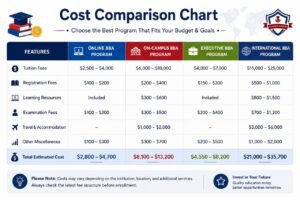
Tuition for online BBA programs varies enormously from a few thousand dollars a year to well over $40,000. Before comparing sticker prices, look at the full picture:
| Factor | What to Check |
| Total tuition | Per credit hour and full program cost |
| Additional fees | Technology, materials, graduation fees |
| Financial aid | Scholarships, grants, employer tuition assistance |
| Payment plans | Monthly or per-term payment options |
| Graduate outcomes | Employment rate, average starting salary |
A lower-cost program isn’t automatically a better deal, and a higher-cost program isn’t automatically superior. Weigh cost against accreditation, outcomes, and support services together.
Check Flexibility and Learning Format
Not all “online” programs work the same way. Some are fully asynchronous, some require live class attendance, and others use a hybrid model.
Consider:
- Can you complete coursework on your own schedule, or are there fixed class times?
- Is the program self-paced, cohort-based, or a mix of both?
- How long does it typically take to graduate 2, 3, or 4 years?
- Are there in-person requirements like exams, internships, or residencies?
If you’re working full-time, an asynchronous or hybrid format usually offers the most sustainable path to graduation.
Look at Student Support and Technology
Good online programs invest as much in student support as they do in curriculum. Before enrolling, check whether the school offers:
- A dedicated learning management system (LMS) that’s easy to navigate
- Technical support for remote learners
- Career services, resume help, and job placement assistance
- Peer networking opportunities, alumni groups, or virtual clubs
- Library access, research databases, and writing centers
Institutions built as a genuine global education platform serving students across different countries and time zones tend to offer more robust digital infrastructure, since that’s core to their operating model rather than an afterthought.
Read Reviews and Talk to Current Students
Marketing materials only tell one side of the story. Before committing:
- Search for independent reviews on sites like Reddit, Trustpilot, or education forums
- Ask the admissions team to connect you with current students or alumni
- Check graduate employment statistics, if published
- Look at how long the program has existed and how it has evolved over time
Consider the Institution’s Global Reputation
If you’re considering studying with an institution outside your home country or one that serves an international student base, reputation and recognition matter even more. Platforms like ED Global Academy position themselves as accessible entry points for students seeking internationally relevant business education without the cost or logistics of relocating.
When evaluating any global-facing institution, verify:
- Whether the degree is recognized in the countries where you might work
- Whether the institution partners with accredited universities
- How the platform supports international students specifically (time zones, visa guidance, local employer recognition)
Red Flags to Avoid
Watch out for programs that show these warning signs:
- No verifiable accreditation information
- Guaranteed admission with no application requirements
- Extremely low tuition with no transparent breakdown of costs
- Pressure to enroll immediately or “limited-time” discount tactics
- No clear faculty information or student outcomes data
Conclusion
Choosing the best online BBA program in the USA comes down to five things: verified accreditation, a relevant curriculum, engaged faculty, transparent cost and outcomes, and genuine student support. Take time to compare programs side by side rather than relying on advertising alone, and don’t hesitate to ask direct questions before you commit.
If you’re exploring options built for flexible, international learners, platforms like ED Global Academy designed as a global education platform are worth researching alongside traditional universities to see which best fits your goals, budget, and schedule.
FAQs
What is a BBA degree used for?
A BBA prepares graduates for entry-level and mid-level roles in management, finance, marketing, operations, and related business fields.
Is an online BBA as respected as an on-campus degree?
Yes, as long as the program holds proper accreditation. Employers generally care more about accreditation and skills than delivery format.
How long does it take to complete an online BBA program?
Most programs take three to four years full-time, though accelerated or credit-transfer options can shorten that timeline.
How much does an online BBA program cost in the USA?
Costs range from roughly $10,000 to $40,000+ for the full degree, depending on the institution, format, and financial aid available.
Can international students enroll in an online BBA program in the USA?
Many programs accept international students, though requirements vary by school. Always confirm visa policies and recognition in your home country.
