
Many teachers reach a point where experience alone is not enough. A school may ask for a formal qualification, or a promotion may need one. Leaving your job to study is not realistic for most people. The good news is that you don’t have to. Here is what an online B.Ed. for teachers really offers when you do it alongside your work.
Also read: What Does an Online Does B.Ed. Include? Eligibility & Course Guide
Can You Really Study for a B.Ed While Teaching Full Time?
Yes, many teachers study for a B.Ed while working. Most programs need a bachelor’s degree with around 50% marks, and the course usually lasts two years. Flexible and part-time formats exist, but you must confirm the program is approved by the right regulators before paying any fee.
Eligibility rules can differ by state and university. Some categories get a relaxation in the minimum marks, so check the official prospectus.
A typical B.Ed covers these areas:
- Child development and learning
- Curriculum and lesson planning
- Assessment methods
- Inclusive education
- Technology in the classroom
- Two teaching subjects of your choice
- School internship and practical work
Because you already teach, much of this will feel familiar. The course gives you the theory and the language behind things you may already do by instinct.
What Are the 10 Benefits of a B.Ed Alongside Your Job?
A B.Ed. gives working teachers a recognized qualification, better job security, stronger classroom skills, and wider career choices, all without leaving a steady income. You also apply lessons in your own classroom the next day. Here are ten benefits, explained simply.
- You keep earning. Your salary continues, so there is no career break or loan pressure from lost income.
- You learn and apply at once. Try a new questioning technique on Monday and see the result by Friday.
- You become eligible for teacher eligibility tests. TET and CTET generally ask for a B.Ed or an equivalent teaching qualification for higher classes.
- Your job security improves. Schools and education boards increasingly prefer trained teachers.
- Classroom management gets easier. You learn why students behave the way they do, not only how to react.
- Your own school can become your practice ground. Some institutions allow internship work at your workplace, but confirm this in writing.
- Promotion becomes possible. Many schools link senior roles and pay-scale growth to a professional degree.
- You gain confidence with modern methods. Activity-based learning, digital tools, and competency-based assessment become part of your toolkit.
- You meet other teachers. Classmates from different schools share ideas you would never hear in your staff room.
- You open the door to higher studies. A B.Ed is the base for an M.Ed, UGC NET, and later a PhD.
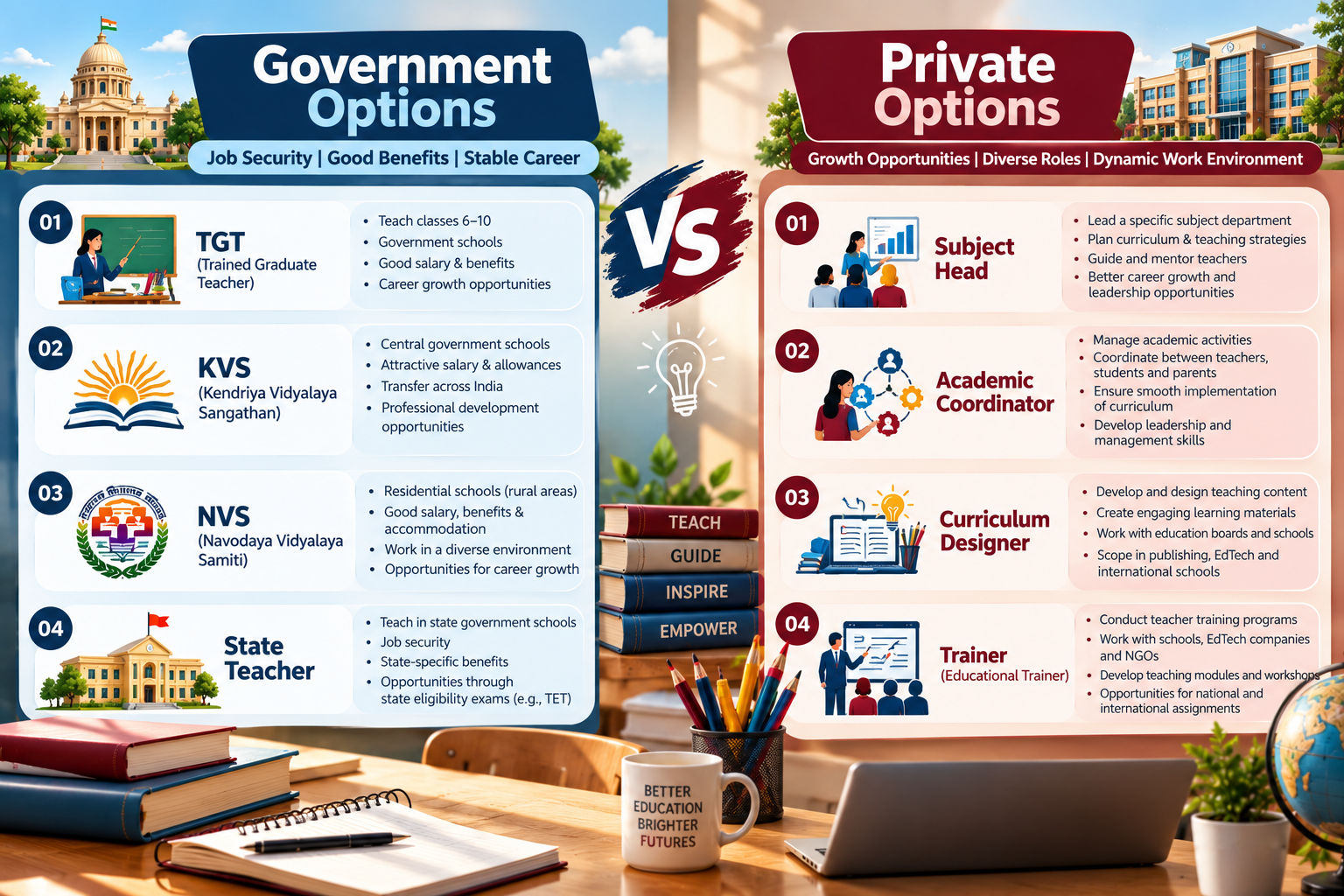
Which Government and Private Jobs Can a B.Ed Lead To?
A B.Ed. opens roles such as government school teacher, trained graduate teacher, and academic coordinator. In private schools, it helps with better posts and subject leadership. Most government teaching posts also need a TET or CTET score, so plan for that exam alongside your degree.
Government options
- State government school teacher (after clearing the relevant TET and recruitment exam)
- Central government schools such as KVS and NVS, which ask for specific qualifications and tests
- Trained graduate teacher posts, which commonly need a B.Ed
Private options
- Teacher or subject head in CBSE, ICSE, or state board schools
- Academic coordinator or vice principal, with experience
- Curriculum designer or content developer for education companies
- Online tutor or coaching faculty
- Teacher trainer
Qualifications alone do not secure these jobs. Employers also look for subject knowledge, communication skills, and classroom results.
Subjects and Skills You Will Build
A B.Ed covers how children learn, how to plan lessons, and how to test understanding. You also choose teaching subjects, such as English, math, science, or social science, based on your graduation.
Common subjects include:
- Childhood and growing up
- Learning and teaching methods
- Curriculum and school systems
- Inclusive education
- Assessment for learning
- Pedagogy of your chosen subjects
hbB
Skills that schools expect from teachers today:
- Clear communication
- Basic digital teaching tools
- Classroom discipline without fear
- Patience with different learning speeds
- Simple record-keeping and assessment
Career Opportunities: Government and Private Jobs
A B.Ed qualifies you for teaching roles in both government and private schools. Government jobs usually need a TET or CTET pass along with the degree. Private schools focus on your interview, demo class, and experience.
Government options:
- State government school teacher (TGT and PGT posts, based on qualification)
- Central schools such as KVS and NVS, through their own exams
- Municipal and local body schools
Private options:
- Teacher or subject coordinator in private schools
- Academic coordinator or vice principal, with experience
- Curriculum and content developer
- Online teacher or tutor
- Coaching and training roles
Competition is high for government posts. Vacancies change each year, so prepare steadily and avoid depending on one exam.
Also read: Career Opportunities After a Bachelor of Education Degree
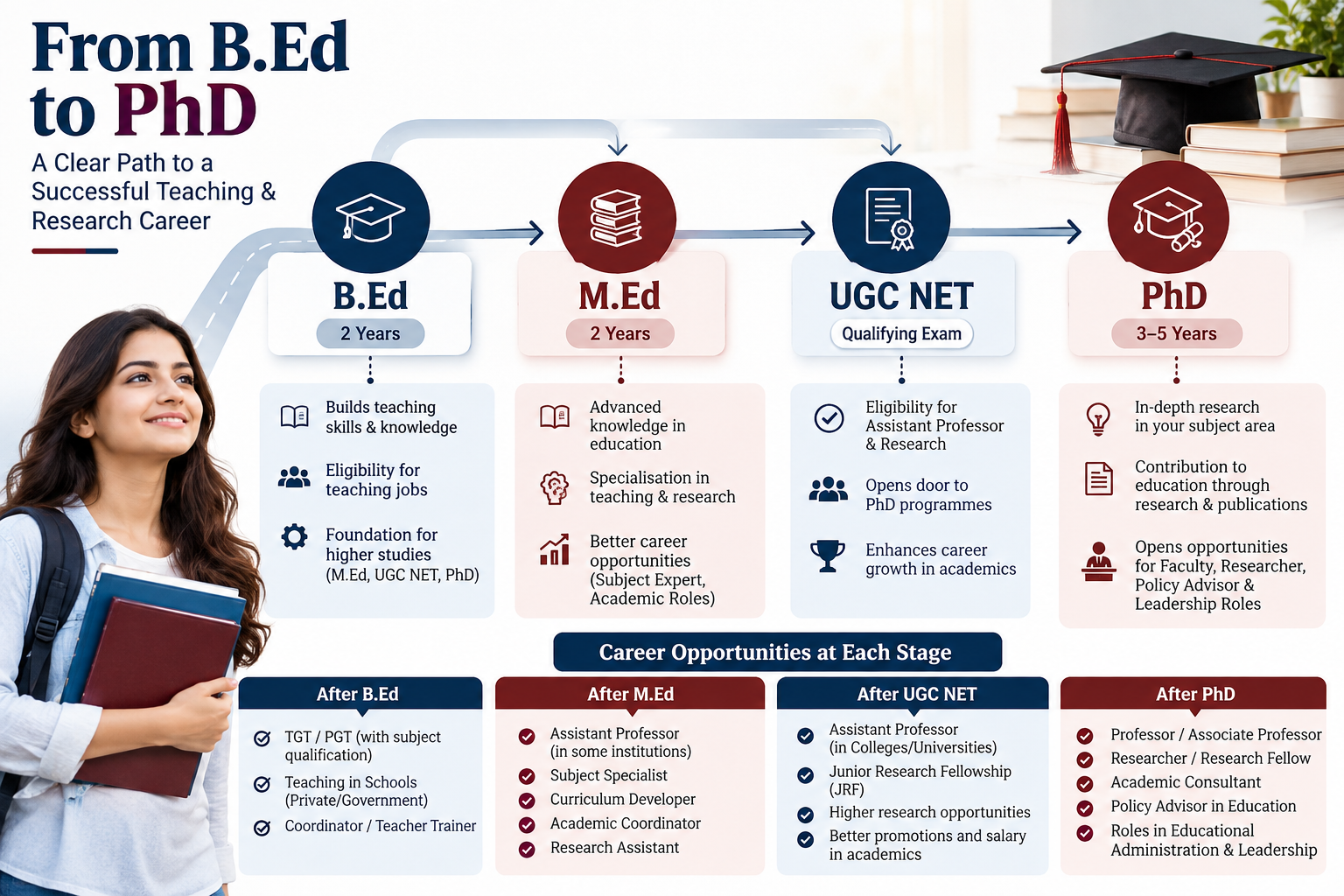
What Is the Future Scope, and Which Higher Studies Can You Choose?
Teaching remains a steady career, and trained teachers are in demand as schools adopt newer methods. After a B.Ed., you can study an M.Ed., an MA in Education, or a subject master’s degree. You can also prepare for UGC NET if you want to teach at college level.
Some trends to keep in mind:
- National Education Policy 2020 puts more focus on skills, foundational learning, and flexible assessment.
- Blended learning is now normal, so digital comfort matters.
- Schools want teachers who can support students with different learning needs.
Useful higher-study paths include:
- M.Ed for teaching, research, or training roles
- UGC NET for assistant professor posts
- Specialized diplomas in special education, counseling, or educational technology
- PhD in Education for research careers
Also read: Best Teaching Careers with an Online B.Ed. Degree in the USA
What Common Mistakes Should Working Teachers Avoid?
The biggest mistake is joining a program without checking its approval. Other common errors include choosing only the cheapest option, ignoring internship rules, and underestimating the workload. A little research before admission can save you two years of effort and a lot of money.
Watch out for these:
-
-
- Skipping verification. Check recognition on official regulator websites, not just the institution’s brochure.
- Ignoring state acceptance. A degree valid in one state may face questions in another.
- Assuming it will be easy. Assignments, practicals, and exams still need regular time.
- Not informing your school. You may need leave for internship days or exams.
- Forgetting TET preparation. The degree and the eligibility test are separate hurdles.
- Choosing by advertisement. Ask former students about their real experience.
-
What Should You Check Before Enrolling?
Before enrolling, confirm the program’s approval, the exam and internship rules, the total fee, and the weekly time commitment. Speak to current students if you can. Make sure the qualification will be accepted for the jobs and promotions you are aiming for.
Use this simple checklist:
- Verify recognition from the relevant national and state authorities.
- Ask for the complete fee structure in writing, including exam and practical charges.
- Understand attendance, internship, and teaching practice requirements.
- Talk to your school about leave and support.
- Compare two or three providers. A global education platform can help you view options in one place, but always cross-check approvals yourself.
- If you shortlist a provider such as Ed Global Academy, ask for its approval documents and syllabus before paying.
- Plan your weekly study hours and protect them like a class period.
Key Takeaways
- A B.Ed. helps working teachers qualify for better roles and promotions.
- You can keep your salary and still study.
- Always verify UGC and NCTE recognition before paying any fee.
- A B.Ed. is usually needed for TET, CTET, and many government teaching posts.
- Salaries vary widely, so avoid believing any promise of a fixed income.
- The degree works best for people who genuinely enjoy teaching.
Conclusion
Earning a B.Ed while teaching is a practical choice for many educators. It protects your income, improves your classroom skills, and prepares you for better jobs. Still, success depends on picking a recognized program and managing your time well.
Take your time, compare options, and confirm every approval yourself. If you want a starting point for comparing programs, a platform such as Ed Global Academy can help you explore courses and ask questions. Make the final decision based on your own goals.
FAQs
- How long does a B.Ed take for working teachers?
The usual duration is two years. Some universities allow a longer window to finish, which helps if work gets busy. - What is the fee for a B.Ed?
Fees vary widely by university and mode of study. Ask for the full fee list, including exam and practical charges, before you pay. - Is a B.Ed. difficult while working full-time?
It is manageable with a weekly plan. The hardest parts are usually assignments and teaching practice, so start early. - Can I get a government teaching job after a B.Ed?
Yes, but you usually need to clear TET or CTET and the relevant recruitment exam. The degree alone does not guarantee a post. - What salary can I expect after a B.Ed?
It depends on your school, city, and experience. Government posts follow set pay scales, while private pay varies.
