
Picking an online MBA sounds easy until you open ten websites and find ten different claims. Every program says it is flexible, recognized, and career-focused. Very few show you how to check those claims yourself.
This guide gives you a clear way to compare options. You will see eligibility, duration, recognition, job outlook, common mistakes, and a checklist, all tied to sources you can verify.
Read more: Top 15 MBA Dissertation Topics for 2026: Trending Research Ideas for Students
What Is a Global Online MBA and How Does It Work?
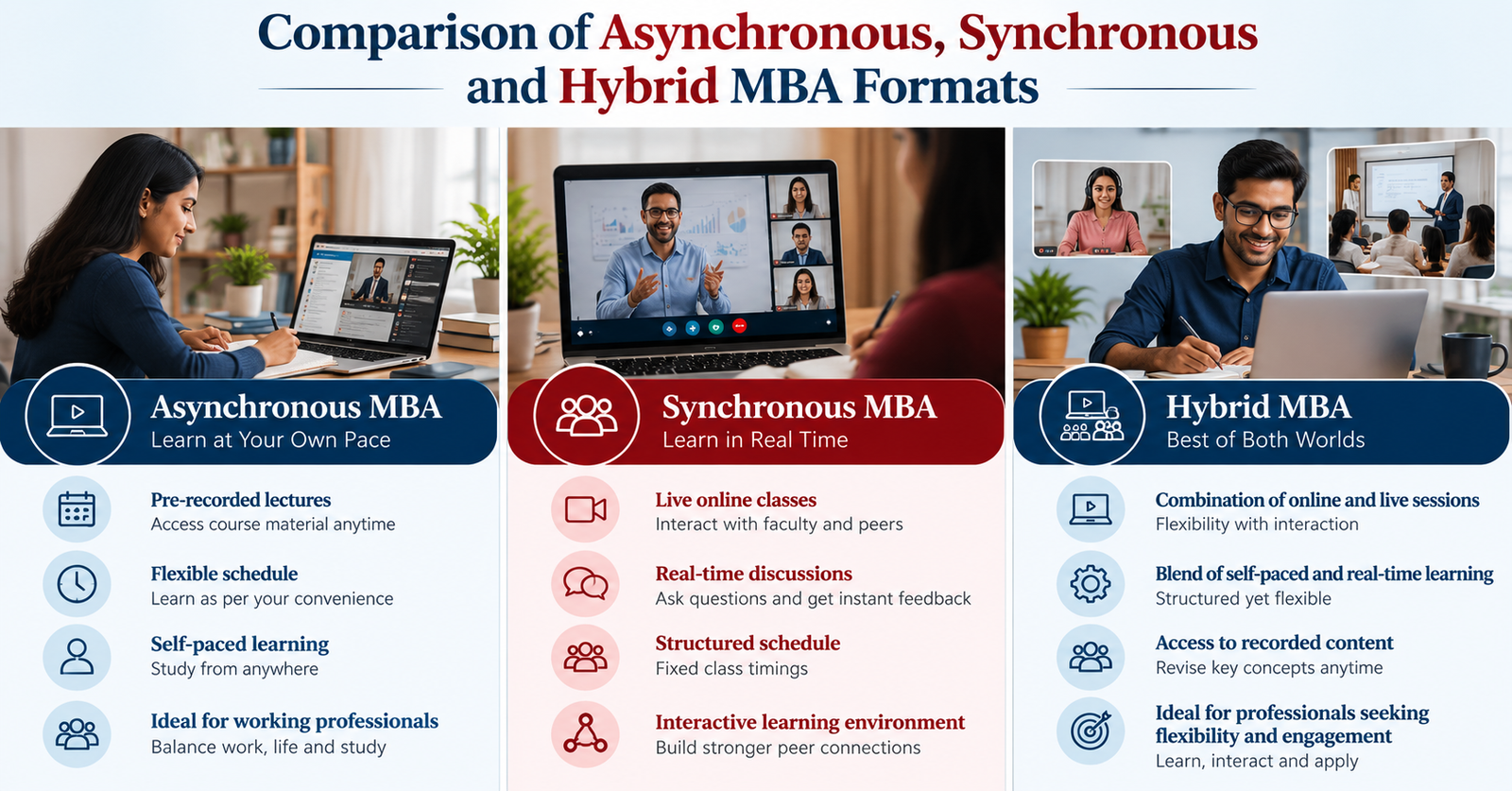
A global online MBA program is a postgraduate management degree taught over the internet. You watch recorded lectures, join live classes, and complete case studies from home. Classmates and faculty may come from many countries, but one university awards the degree, and its recognition is what employers check first. The subjects are the same as in a campus MBA. What changes is how you study. You need more self-discipline, and you get fewer chances to meet people in person.The word “global” is often a marketing word. Ask three questions instead. Who awards the degree? Who recognizes it? Where will it be accepted?

Who Is Eligible for an Online MBA?
Most programs ask for a bachelor’s degree from a recognized university. Many Indian universities want around 50% marks, and some accept 45% for SC/ST candidates. Work experience is often optional but useful. Entrance exams like CAT or GMAT are usually not compulsory for online admission, but rules differ by university.
Keep these ready:
- A three-year bachelor’s degree certificate and mark sheets
- Identity proof and recent photographs
- Work experience letters, if you have them
- An English test score, if you apply to a university abroad
For Indian programs, ask whether a DEB-ID or ABC ID is required before you enroll. Requirements change by year.
How Long Does It Take, and What Will You Study?
Most online MBAs run for two years across four semesters. Some Indian universities allow extra time to finish, and some programs abroad offer faster tracks. Always read the exact duration and maximum completion time in the prospectus.
You will usually study:
- Core subjects: accounting, marketing, operations, organizational behavior, business analytics, and strategy
- Specializations: finance, HR, marketing, operations, or business analytics
Here is a simple example. A marketing executive who wants to move into a leadership role may keep marketing as their specialization. Someone switching careers may pick finance or analytics to build a new skill.
How Do You Check Recognition and Accreditation?
Start with the regulator. In India, check whether the university and the exact program appear on the UGC-DEB website (deb.ugc.ac.in) for your admission year. For international schools, look for AACSB, AMBA, or EQUIS, and confirm the status on the accreditor’s own website, not in the school’s brochure.
The three accreditors look at different things. AACSB covers the whole business school. AMBA focuses on MBA programs. EQUIS, run by EFMD, puts weight on international exposure. A school holding all three is called “triple crown” or “triple accredited,” which is an industry term, not an official title.
Use this process:
- Write down the exact program name and specialization.
- Search for it on the regulator or accreditor website.
- Save a screenshot with the date.
- Ask admissions to confirm recognition in writing.
NAAC grades and NIRF ranks are useful extra signals. They do not replace the program-level check.
Will Employers Accept It? Jobs, Salary, and Future Scope
Acceptance depends on the university’s reputation, its accreditation, and your own skills. GMAC’s recruiter survey found that the share of global recruiters who value online and in-person graduates equally rose from 34% in 2021 to 60% in 2022, though the United States was an exception. Treat this as a trend, not a promise.
Private jobs: Common roles include business analyst, marketing manager, operations manager, HR manager, and finance executive. Most employers care about your experience as much as your degree.
Government jobs: Many public roles accept UGC-recognized degrees. Each recruitment notice sets its own conditions, so read it carefully before you enroll.
Salary: No honest single figure exists. Pay depends on your past experience, city, industry, and the school. Check audited placement reports, NIRF data for Indian institutions, GMAC reports, and alumni profiles on LinkedIn. Be careful with “100% placement” claims.
Higher studies: Options include a doctorate in management (DBA or PhD) or professional courses such as CFA or FRM.
Online MBAs tend to work best as a promotion or career-switch tool for people who already work.
What Common Mistakes Do Students Make?
The most common mistake is choosing a program on fees and promises instead of recognition and fit. These errors cost students time and money, and most are easy to avoid.
- Choosing the cheapest option without checking recognition
- Believing placement claims with no audited report
- Ignoring weekly study hours and exam rules
- Missing hidden costs such as exam fees and study material
- Expecting the degree alone to get a job
- Never speaking to current students or alumni
A good habit is to ask for the full fee breakdown and a sample class before you pay.
Who Should Choose It and Who Should Avoid It?
An online MBA suits you if you already work, cannot relocate, can study on your own, and want growth in your current field. It also helps if you want to switch roles and can use your experience to support the move.
Think twice if you:
- Depend on campus placements and a strong in-person network
- Struggle to study without fixed classes
- Are aiming for a job or exam that asks for a regular full-time degree
- Want to join only because a friend or advertisement told you to
Key Takeaways
- Check recognition at the program level, not just the university name.
- Verify accreditation on the accreditor’s official website.
- Most online MBAs take about two years, but confirm the exact duration.
- Eligibility usually means a bachelor’s degree with a minimum percentage.
- Employer acceptance is improving, but it is not guaranteed.
- Ask for audited placement data before believing any salary claim.
Conclusion
The right choice comes down to a few checks: recognition, accreditation, total cost, study time, and honest career outcomes. Do these before you pay a single rupee. Speak to alumni and read the fine print. A slower, careful decision is better than a quick one you regret later.
If you want help comparing options, ED Global Academy, a global education platform, can be one place to start your research. Verify every claim with the official sources below.
FAQs
- How long is an online MBA?
Most programs take two years, split into four semesters. Check the maximum completion time too. - What are the fees?
Fees vary widely by university and country. Compare the total cost, including exam fees and study material. - Is an online MBA difficult?
The content is similar to a campus MBA. The main challenge is managing your time alongside work or family. - Can I get a job after an online MBA?
Yes, it can help, especially if you already have experience. The degree supports your career, but it does not guarantee a job. - What salary can I expect?
It depends on your experience, industry, city, and school. Use audited placement reports instead of advertised averages.
