
If you’ve searched for an online honorary doctorate, chances are you’ve also run into a lot of vague marketing language and not much straight talk. Who actually qualifies? What it costs. Whether it’s legally the same as a PhD. Whether you really don’t have to fly anywhere or attend a ceremony in person.
This guide answers those questions directly, with a UK focus. We’ll walk through what makes a program genuinely “online,” how the nomination and conferral process works, what you should expect to pay, and probably the most searched question on this topic: whether an honorary PhD online carries the same legal weight as an earned doctorate. We’ll also cover the accrediting bodies worth checking before you commit to any program.
What Does “Online” Actually Mean for an Honorary Doctorate?
Not every program that calls itself online actually is. Some still require a campus visit for the final ceremony or a mandatory in-person interview. A genuinely remote online honorary doctorate should include a few specific things:
- No residency requirement. You complete the entire nomination and review process from wherever you live, with no mandatory travel.
- Digital conferral. Instead of walking across a stage, you receive your recognition through a virtual ceremony, live-streamed event, or recorded presentation.
- Remote nomination. Your application, supporting documents, and references are submitted and reviewed entirely online, often through a secure portal or email exchange.
- Digital credential delivery. Your honorary PhD certificate and any supporting documentation arrive as verified digital files, sometimes followed by a physical parchment shipped to your address.
This setup is sometimes described using the term “distance recognition” or “non-resident honorary degree,” meaning the honoree never needs to set foot on campus to receive the distinction. For professionals with limited time or those based outside the awarding institution’s home country, this format is the main draw.
How the Online Nomination Process Works
Most legitimate programs follow a similar sequence, even if the exact steps vary slightly by institution:
- Nomination submission – You or a nominator submits a profile outlining your professional achievements, leadership contributions, or community impact.
- Document review – The awarding body reviews your CV, letters of support, and any supplementary evidence of your work.
- Committee evaluation – A panel assesses whether your contributions meet the criteria for recognition. This step separates credible programs from ones that will approve anyone who pays.
- Approval and notification – If approved, you’re notified and given details on the conferral date and format.
- Digital or hybrid conferral – You receive your honorary distinction through a virtual ceremony, and your honorary PhD certificate is issued digitally, often with a physical copy mailed afterward.
The entire process, from nomination to conferral, typically takes anywhere from a few weeks to a few months, depending on how quickly documents are submitted and reviewed.

Online Honorary Doctorate Cost: What to Expect
Cost is one of the most commonly searched and least transparently answered parts of this topic. Pricing for an online honorary doctorate generally depends on what’s included in the package: the review process, the certificate itself, shipping for physical parchments, and whether a virtual ceremony or media kit is bundled in.
Here’s a general breakdown of what shapes the price:
| Cost Factor | What It Covers |
| Application and review fee | Administrative cost of evaluating your nomination |
| Certificate production | Design, printing, and authentication of your honorary PhD certificate |
| Shipping and handling | Delivery of physical documents internationally |
| Virtual ceremony access | Live-streamed or recorded conferral event |
| Add-on packages | Media features, press releases, or additional certified copies |
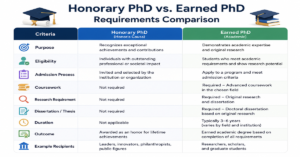
Honorary PhD vs. Earned PhD: The Distinction That Matters
This is where most confusion starts, and it’s worth being direct about it.
An honorary PhD degree is a title conferred in recognition of a person’s achievements, contributions, or standing in their field. It is not the result of coursework, research, or a dissertation defense. An earned PhD, by contrast, involves years of academic study, original research, and formal examination.
In the UK, this distinction has practical consequences:
- Honorary doctorate holders are generally expected to use the title “Dr.” only in specific, clearly identified contexts (such as alongside “honorary” or “hon.” on formal documents), not to imply an earned academic doctorate.
- Universities with genuine degree-awarding powers in the UK operate under authorization from the Privy Council and are listed on the Office for Students (OfS) register. This is different from organizations that offer honorary recognition without holding accredited degree-awarding status.
- Using an honorary title to imply you hold an earned doctorate, particularly in professional, medical, or legal contexts, can create legal and ethical problems. Always check how the awarding body itself recommends the title be used.
This is also where the term “honoris causa” comes in, the traditional Latin phrase used on many honorary doctorate certificates, meaning “for the sake of honor,” which distinguishes it from an earned academic qualification.

Accreditation: What to Actually Check
The original guide for this topic mentioned “respected national and international organizations” without naming any. That’s not enough for someone trying to verify legitimacy. Here’s what to look for instead:
- Degree-awarding powers (UK): Confirm whether the institution holds authorized degree-awarding powers through the Office for Students or whether it operates as a private awarding body without that status.
- Institutional accreditation (US-based programs): If the awarding body is US-based, check whether it holds accreditation from a recognized regional or national accreditor.
- Transparency about status: A credible program will clearly state whether its recognition is an honorary distinction rather than an academic credential and will not imply equivalence to an earned doctorate.
If a program can’t clearly explain its accreditation status or dodges the question, treat that as a warning sign regardless of how polished its marketing looks.
Is an Online Honorary Doctorate Worth It?
For many recipients, the value isn’t academic; it’s recognition. Business leaders, philanthropists, authors, and community figures often pursue an honorary PhD online as formal acknowledgment of work already done, not as a substitute for further education.
If your goal is career advancement that requires an accredited academic credential, an honorary doctorate won’t serve that purpose. If your goal is public recognition of established achievement, and you’re clear-eyed about what the title does and doesn’t represent, it can be a meaningful addition to your professional profile.
ED Global Academy, for instance, positions its honorary nomination pathway as a recognition-based program rather than an academic degree, which is the kind of clarity worth looking for elsewhere too.
Conclusion
An online honorary doctorate can be a legitimate way to receive recognition for meaningful achievements without travel or residency requirements. Whether you apply through a global education platform or directly through a recognized institution, it is important to understand the difference between an honorary title and an earned PhD, verify the awarding body’s accreditation or degree-awarding authority, and review all associated costs before making a decision. When these key factors are carefully evaluated, a remote nomination and digital conferral process can provide a simple, transparent, and convenient way to receive recognition for your accomplishments.
Frequently Asked Questions
Can I receive an honorary PhD entirely online without traveling?
Yes. Many programs now offer fully remote nomination, review, and conferral, including virtual ceremonies and digital certificate delivery, so you never need to visit the awarding institution.
Is an honorary PhD the same as an earned PhD?
No. An honorary PhD recognizes achievement or contribution in a field, while an earned PhD requires original research, coursework, and examination. They are not academically equivalent, and the two should not be presented as the same credential.
How much does an online honorary doctorate program cost?
Cost varies by provider and depends on what’s included, such as the review process, certificate production, shipping, and any ceremony or media add-ons. Always ask for an itemized breakdown before paying.
What is an honorary PhD certificate, exactly?
It’s the formal document issued to confirm the honorary recognition, typically including the recipient’s name, the awarding institution, and language such as “honoris causa” to indicate it is an honorary distinction rather than an earned degree.
Does the UK regulate who can issue an honorary doctorate?
There’s no single body that regulates honorary titles specifically, but institutions with genuine degree-awarding powers are listed on the Office for Students register. It’s worth checking whether an awarding body holds that status or operates independently of it.
)