If you’re weighing whether a business degree is worth your time and tuition, one question comes up before almost any other: what does BBA salary actually look like once you graduate? The honest answer is it depends on your specialization, your experience level, and where in the world you’re working.
This guide breaks down real, sourced numbers for BBA graduate salary by career path, pays the average salary after a BBA across common roles, and shows what your BBA starting salary might realistically look like in your first job out of school. Whether you’re just researching programs or already enrolled and planning your next move, this article gives you a clear, data-backed picture of what to expect.
What Is the Average BBA Salary in 2026?
The average salary after a BBA varies by data source, but most reputable salary trackers converge on a similar range. According to PayScale, professionals holding a bachelor of business administration report salaries typically ranging from around $52,000 to $146,000 depending on role, employer, and seniority. ZipRecruiter’s 2026 data puts the average BBA graduate salary in the U.S. at roughly $89,650 per year, with the middle 50% of earners falling between about $65,500 and $116,500 annually.
For comparison, the U.S. Bureau of Labor Statistics tracks business and financial operations occupations as earning a median wage well above the national median for all occupations, a strong signal that a business degree remains one of the more reliably strong-earning bachelor’s paths available today.

BBA Starting Salary: What to Expect in Your First Job
Your BBA starting salary, meaning your pay in the first one to two years after graduation, will typically sit toward the lower end of the overall range, since salary trackers include senior professionals in their averages. Based on entry-level job posting data:
- Business Analyst (entry-level): roughly $50,000–$65,000
- Marketing Coordinator/Assistant: roughly $42,000–$55,000
- Junior Financial Analyst: roughly $55,000–$70,000
- HR Coordinator: roughly $40,000–$52,000
- Operations Associate: roughly $45,000–$58,000
These figures will shift depending on your city, industry, and whether you studied through a globally recognized global education platform with strong employer partnerships and career support versus a program with limited industry connections.
BBA Graduate Salary by Specialization
Not all BBA tracks lead to the same pay ceiling. Here’s how BBA graduate salary typically breaks down by specialization:
| Specialization | Entry-Level Range | Mid-Career Range |
| Finance & Investment Banking | $55,000–$75,000 | $100,000–$150,000+ |
| Accounting & Management Accounting | $50,000–$65,000 | $85,000–$115,000 |
| Operations & Supply Chain | $48,000–$65,000 | $80,000–$110,000 |
| Marketing & Digital Strategy | $45,000–$60,000 | $75,000–$110,000 |
| Human Resources (HR) | $42,000–$58,000 | $70,000–$95,000 |
| Entrepreneurship / Startups | Highly variable | Highly variable |
Finance and accounting tracks tend to command the highest ceilings, while marketing and HR trade a slightly lower starting point for strong long-term growth into management roles.
Top-Paying Roles for BBA Graduates
Some of the strongest long-term career paths for BBA holders include:
- Financial Analyst evaluating markets, forecasts, and investment decisions
- Business Analyst connecting data, strategy, and operations
- Marketing Manager leading brand and growth strategy
- Operations Manager overseeing supply chain and process efficiency
- HR Manager driving talent strategy and organizational development
- Management Consultant advising organizations on performance, often a stepping stone toward an MBA
With enough experience, some graduates move into senior leadership roles like COO or CEO, which carry the highest earning ceilings in the field, though these typically require 15+ years of experience and often an additional graduate credential.
Does Region Affect BBA Salary?
Yes, significantly. If you’re studying through an international, globally recognized global education platform, it’s worth understanding how pay shifts by region:
- United States: generally the highest average salaries for BBA graduates, especially in finance
- Europe / EU-aligned markets: lower nominal pay than the U.S., often offset by lower cost of living
- Middle East & Gulf region: competitive, often tax-free salaries in finance and consulting
- Asia-Pacific: wide variance Singapore and Hong Kong can rival Western pay, while other markets offer lower nominal salaries but faster career growth
Is a BBA Worth It? A Quick ROI Check
Business professionals without a bachelor’s degree average around $45,000 per year, compared to roughly $80,000–$90,000 for BBA graduates over a full career. That gap compounds significantly over 30-40 years, typically outweighing total tuition cost, especially for accredited programs with strong career support built in.
Programs like the BBA offered through ED Global Academy are designed with this outcome in mind, combining accredited coursework with career mentorship and practical, project-based learning meant to shorten the path from graduation to a strong first offer.
BBA vs. MBA Salary
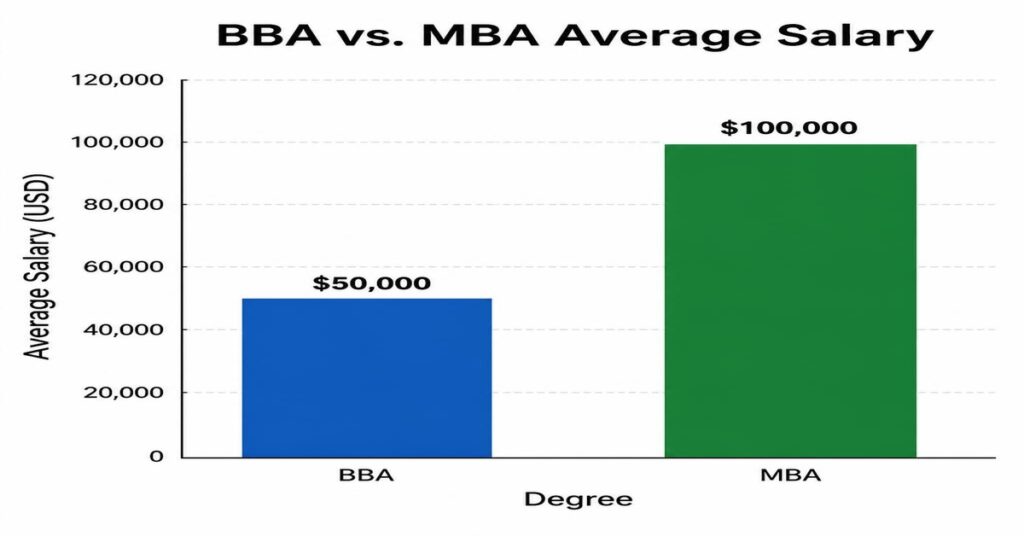
MBA graduates earn roughly 30–40% more on average than BBA graduates, around $120,000 per year compared to $80,000–$90,000. But the MBA is designed as an advanced credential for people who already have work experience, not a replacement for the BBA. Most MBA students already hold a BBA (or equivalent) plus two to five years of professional experience before enrolling.
Conclusion
A BBA remains one of the more reliably strong-earning undergraduate degrees available, with BBA salary outcomes shaped heavily by your specialization, the roles you pursue, and where you choose to work. Whether you’re evaluating your BBA starting salary expectations or planning a longer-term path toward management and eventually an MBA, the data shows a clear, compounding earnings advantage over not holding a degree at all.
If you’re ready to explore what a BBA could look like for your own career, take a look at the accredited program options and career support available to help you get there.
FAQs
What is the average BBA salary in 2026?
Most sources place the average salary after a BBA between roughly $80,000 and $90,000 per year across a full career, with wide variance by role, region, and specialization.
What is a typical BBA starting salary?
Entry-level BBA graduates typically earn between $40,000 and $70,000 in their first job, depending on role and industry. Finance and accounting roles tend to start higher than marketing or HR roles.
Which BBA specialization has the highest graduate salary?
Finance and accounting specializations generally lead to the highest BBA graduate salary, both at entry-level and mid-career.
Does location affect BBA salary?
Yes. The U.S. generally offers the highest nominal BBA salaries, while European, Middle Eastern, and Asia-Pacific markets vary widely based on cost of living and industry demand.
Is a BBA degree worth it financially?
For most career paths, yes, BBA graduates typically out-earn non-degree holders by a significant, compounding margin over a full career.
How does a BBA salary compare to an MBA salary?
MBA graduates earn roughly 30-40% more on average, but the MBA is meant to be pursued after work experience, not as a substitute for a BBA.
